
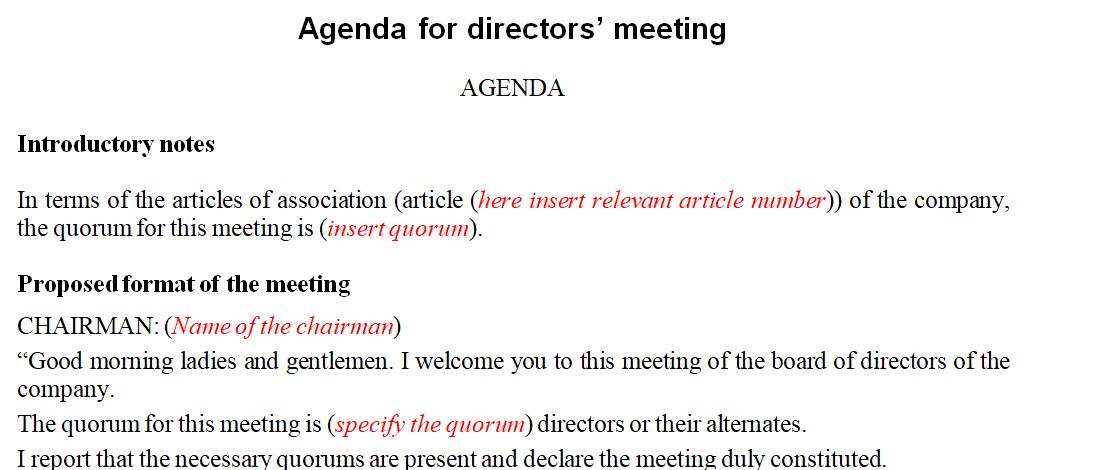
Agenda for Directors Meeting
FREE

Ask the similar questions
Agenda for Directors Meeting
Agenda for Director’s Meeting
A board meeting agenda serves as the roadmap for the chair and acts as the driving force of your meetings. It helps you move between meeting subjects and addresses all business items, while not dwelling too long on specific issues that are better addressed in committee meetings.
The Companies Act regulates board meetings in section 7 which provides that, among other things, the minutes must include declarations of personal financial interests and resolutions adopted, as well as that minutes are evidence of the proceedings at the meeting.
Minutes of board and board committee meetings form part of the company’s records and can be held as hard copies or in electronic format, but must be capable of being reproduced in hard copy form. (In this regard refer to sections 24(1) and 24(3)(f) of the Companies Act).
The decision on which format to use should be confirmed at a board meeting and formally recorded.
For companies, directors’ fiduciary duties and the duty of care skill and diligence are partly codified in section 76. Fiduciary duties include, but are not limited to, a duty to act in good faith and in the best interest of the company, a duty to act within the limits of authority and to exercise powers for a proper purpose, a duty to maintain an unfettered discretion and a duty to avoid conflicts of interests.
Section 75 places specific obligations on directors when dealing with personal financial interests and it is crucial to minute that such procedures were followed where applicable.
The purpose of minutes is to provide an accurate record of the decisions made (including resolutions passed and actions decided on) at the meeting with sufficient context on key discussion points to demonstrate that the directors discharged their duty of due care, skill and diligence to enjoy protection of the business judgement rule.
Minutes provide evidence that directors met their statutory and regulatory duties, as well as the responsibilities set out in the board and committee charters. Minutes should provide sufficient context to enable the person reading the minute to understand key discussion points between participants in arriving at the conclusion.
The function and content of minutes will vary across sectors and between companies.
Minutes of board meeting are internal records of the company and, as such, shareholders have no legal right to see board minutes. However, as noted above, some organisations such as regulatory bodies may choose to publish minutes of board meetings and associated papers.
Careful consideration should be given to a decision to publish details of internal matters in this way and consideration should be given to the potential impact on this important decision-making function within the organisation.
Auditors sometimes request to see board minutes as part of their audit inspection. Some companies will allow this, others only allow the audit partner to read the minutes, and others will only allow them to see specific minutes.
In some regulated sectors, the regulator will request copies of board minutes.
What is Required:
• Your board meeting agendas do not always have to look the same. Change your board meeting by turning your agenda upside down and addressing the most important (and potentially game- changing) information first. It is much easier to generate new ideas when board members’ minds are fresh.
• Note if a topic is meant to inform, seek information, or arrive at a decision. Knowing the end goal of each given board meeting agenda item makes it much easier to achieve it. Otherwise, you may reach your objective without realizing it and then waste time looking for another solution you do not need.
• Allot a set amount of time for each agenda item. If you do not reach the desired conclusion, keep it on the board meeting agenda for next time, and focus on solving the problems that you can right now. If everyone knows it is time to move on, wrapping up the discussion is much easier.
Once you have created a board meeting agenda with actionable discussion points and key decision-making items, you should share it with your board members.
Sharing it in advance gives members the opportunity to fully prepare and actively contribute, especially if they are assigned to cover one of the items.
With sufficient review time, your board meeting agenda will give board members some level of detail about discussion items and inspire provocative questions to bring up to initiate effective collaboration. When documents and reports are attached to the board meeting agenda, members can review them at their leisure and use meeting time for discussion. Or, better yet, they can focus on the strategic issues facing your non-profit. After all, your board meetings should focus on the future of the organization.
By sending your board meeting agendas out in advance, members can relax knowing the meeting is under control and that all pressing issues are accounted for.
On a similar note, you should try to include any pertinent information that arises during a board meeting. Remember, boards have legal liability, and minutes serve as an official and legal record. In a legal arena, meeting minutes are presumed to be correct, so keep language clear and simple to avoid any complications. Use these details as a strong starting point:
• The meeting place, date, and exact time it was called to order;
• The type of meeting (regularly scheduled, special, or called);
• Full names of the meeting participants and absentees;
• Each motion, including who made it, who seconded it, and what the outcome was;
• Action items and next steps;
• Next meeting date and time;
• Time of adjournment.
The Set Protocols for Taking and Approving Minutes.
Once your meeting minutes are complete, you need to have some actionable next steps set in place to quickly finalize them and distribute them to board members in a timely fashion. Your best bet is to have a checklist that keeps you on track.
Improve your digital strategy by using technology to your advantage and taking minutes on a laptop. This way, it is much quicker to jot down important information and reorder it as you go when discussion varies from the agenda. Not only is this much more efficient, but when working from home, there’s an increased need for a more technological approach.
Be sure to efficiently type keywords, brief sentences, and notations directly onto the agenda. Then, outline any series of suggestions and comments in a bullet-point style for quick reference.
A board meeting agenda serves as the roadmap for the chair and acts as the driving force of your meetings. It helps you move between meeting subjects and addresses all business items, while not dwelling too long on specific issues that are better addressed in committee meetings.
The Companies Act regulates board meetings in section 7 which provides that, among other things, the minutes must include declarations of personal financial interests and resolutions adopted, as well as that minutes are evidence of the proceedings at the meeting.
Minutes of board and board committee meetings form part of the company’s records and can be held as hard copies or in electronic format, but must be capable of being reproduced in hard copy form. (In this regard refer to sections 24(1) and 24(3)(f) of the Companies Act).
The decision on which format to use should be confirmed at a board meeting and formally recorded.
For companies, directors’ fiduciary duties and the duty of care skill and diligence are partly codified in section 76. Fiduciary duties include, but are not limited to, a duty to act in good faith and in the best interest of the company, a duty to act within the limits of authority and to exercise powers for a proper purpose, a duty to maintain an unfettered discretion and a duty to avoid conflicts of interests.
Section 75 places specific obligations on directors when dealing with personal financial interests and it is crucial to minute that such procedures were followed where applicable.
The purpose of minutes is to provide an accurate record of the decisions made (including resolutions passed and actions decided on) at the meeting with sufficient context on key discussion points to demonstrate that the directors discharged their duty of due care, skill and diligence to enjoy protection of the business judgement rule.
Minutes provide evidence that directors met their statutory and regulatory duties, as well as the responsibilities set out in the board and committee charters. Minutes should provide sufficient context to enable the person reading the minute to understand key discussion points between participants in arriving at the conclusion.
The function and content of minutes will vary across sectors and between companies.
Minutes of board meeting are internal records of the company and, as such, shareholders have no legal right to see board minutes. However, as noted above, some organisations such as regulatory bodies may choose to publish minutes of board meetings and associated papers.
Careful consideration should be given to a decision to publish details of internal matters in this way and consideration should be given to the potential impact on this important decision-making function within the organisation.
Auditors sometimes request to see board minutes as part of their audit inspection. Some companies will allow this, others only allow the audit partner to read the minutes, and others will only allow them to see specific minutes.
In some regulated sectors, the regulator will request copies of board minutes.
What is Required:
• Your board meeting agendas do not always have to look the same. Change your board meeting by turning your agenda upside down and addressing the most important (and potentially game- changing) information first. It is much easier to generate new ideas when board members’ minds are fresh.
• Note if a topic is meant to inform, seek information, or arrive at a decision. Knowing the end goal of each given board meeting agenda item makes it much easier to achieve it. Otherwise, you may reach your objective without realizing it and then waste time looking for another solution you do not need.
• Allot a set amount of time for each agenda item. If you do not reach the desired conclusion, keep it on the board meeting agenda for next time, and focus on solving the problems that you can right now. If everyone knows it is time to move on, wrapping up the discussion is much easier.
Once you have created a board meeting agenda with actionable discussion points and key decision-making items, you should share it with your board members.
Sharing it in advance gives members the opportunity to fully prepare and actively contribute, especially if they are assigned to cover one of the items.
With sufficient review time, your board meeting agenda will give board members some level of detail about discussion items and inspire provocative questions to bring up to initiate effective collaboration. When documents and reports are attached to the board meeting agenda, members can review them at their leisure and use meeting time for discussion. Or, better yet, they can focus on the strategic issues facing your non-profit. After all, your board meetings should focus on the future of the organization.
By sending your board meeting agendas out in advance, members can relax knowing the meeting is under control and that all pressing issues are accounted for.
On a similar note, you should try to include any pertinent information that arises during a board meeting. Remember, boards have legal liability, and minutes serve as an official and legal record. In a legal arena, meeting minutes are presumed to be correct, so keep language clear and simple to avoid any complications. Use these details as a strong starting point:
• The meeting place, date, and exact time it was called to order;
• The type of meeting (regularly scheduled, special, or called);
• Full names of the meeting participants and absentees;
• Each motion, including who made it, who seconded it, and what the outcome was;
• Action items and next steps;
• Next meeting date and time;
• Time of adjournment.
The Set Protocols for Taking and Approving Minutes.
Once your meeting minutes are complete, you need to have some actionable next steps set in place to quickly finalize them and distribute them to board members in a timely fashion. Your best bet is to have a checklist that keeps you on track.
Improve your digital strategy by using technology to your advantage and taking minutes on a laptop. This way, it is much quicker to jot down important information and reorder it as you go when discussion varies from the agenda. Not only is this much more efficient, but when working from home, there’s an increased need for a more technological approach.
Be sure to efficiently type keywords, brief sentences, and notations directly onto the agenda. Then, outline any series of suggestions and comments in a bullet-point style for quick reference.
Legal App FREE Download - We Handle Your Case On The Go