
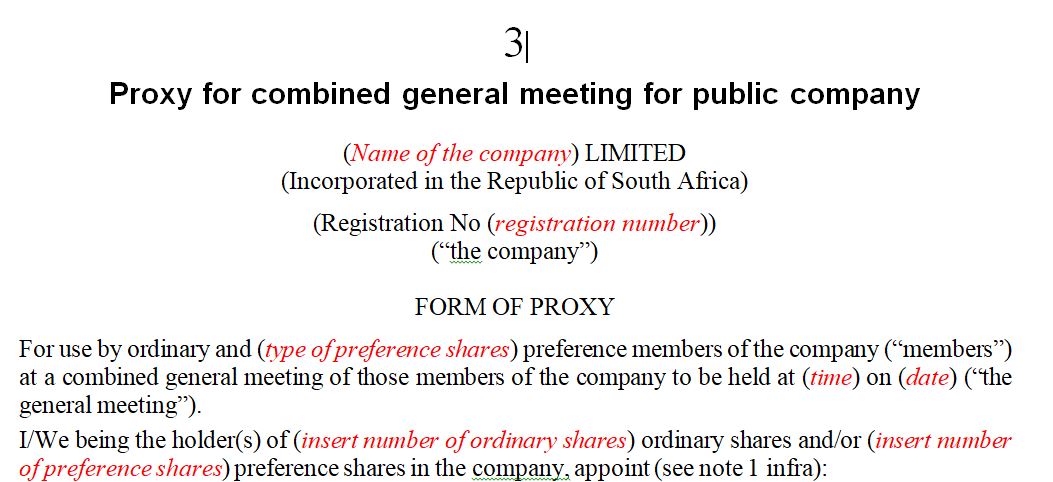
Proxy for combined general meeting for public company
FREE

Ask the similar questions
Proxy for combined general meeting for public company
Proxy for combined general meeting for public company
Proxy for combined general meeting for public company
Traditionally, voting has taken place at general meetings on a show of hands but more companies are now routinely conducting voting by a poll.
Voting is to be decided at a general meeting by a show of hands, unless a poll is demanded.
Every member present in person, or by proxy, has one vote on a show of hands, regardless of the number of shares held. Members may appoint multiple proxies, provided each proxy represents a different part of the holding, each of whom will have a vote on a show of hands.
The potential for shareholder activists holding only a small number of shares to distort voting on a show of hands by appointing multiple proxies has encouraged the move by companies towards voting by poll.
A proxy has one vote for and one vote against a resolution on a show of hands where they have been appointed by more than one member and the proxy has been instructed to vote in different ways by the different members.
A duly authorised representative appointed by a corporation may also vote on a show of hands. Where a company appoints more than one representative, each representative can exercise the votes attached to the relevant shares in different ways, provided each representative is voting different shares.
It is the chairman’s responsibility to count the votes on a show of hands and his/her declaration of the result is conclusive without the need to announce votes for or against.
Although the voting may be by a show of hands preparation should be made for the fact that a poll may be demanded at the meeting.
Proxy votes are usually displayed on a screen after the result on the show of hands for each resolution and also to be made available to shareholders at the end of the meeting in order to comply with the requirement for listed companies to declare proxy votes.
Who can Demand a Poll?
The company’s MOI will set out the rules governing demanding of a poll. The Act prescribes that provisions in the MOI for demanding a poll must not specify more than:
• Five members having the right to vote;
• A member or members representing at one-tenth of the total voting rights of all members having the right to vote on the resolution; or
• By a member or members holding shares on which an aggregate sum has been paid up equal to at one-tenth of the total sum paid on all such shares.
A company’s MOI may allow for a more favourable position with respect to calling a poll. The Model MOI for both private and public companies allow for a poll to be called by:
- The chairman of the meeting;
- The directors;
- Two or more persons having the right to vote on the resolution; or
- A person or persons representing not less than one-tenth of the total voting rights of all the members having the right to vote on the resolutions.
It should be noted that proxies are able to participate in the demand for a poll.
The chairman may also call a poll if he/she has been appointed proxy by the requisite number of shareholders.
The chairman should demand a poll where voting on a show of hands is unclear or if he/she is aware that the outcome of the vote on a show of hands does not reflect the position of the proxy votes registered. The chairman should be provided with a draft script covering this eventuality should it arise.
If a poll is correctly requested by shareholders during the meeting the chairman is obliged to comply with the request. However, it is acceptable for the chairman to point out the number of proxy votes that he holds and ask whether they wish to withdraw their request. If the shareholders insist then the poll must proceed.
If a chairman improperly refuses to take a poll where it has been properly requested any resolution passed on a show of hands will be invalid and ineffective.
Holding a Poll
It is normal for a company’s MOI to stipulate that a poll on the election of a chairman or on adjournment of the meeting must be taken immediately but a poll on any other question can be taken either immediately or at any time, place and date within the next thirty days directed by the chairman.
It is now common, particularly in the case of companies with a large shareholder base, for it to be decided beforehand that the business at general meetings will be voted on by a poll.
Where it has been decided before the meeting to conduct voting by a poll steps can be taken to ensure voting is carried out smoothly:
1. The notice of meeting should clearly set out that voting will be by poll and explain the reasons for this.
2. Scrutineers: It is advisable to appoint scrutineers to assist with conducting the poll even where the articles do not oblige the company to do so. It is usual for the scruntineers to be either the company’s auditors or registrars, both of whom will be seen as having a measure of independence from the company. The scrutineers will be responsible for issuing poll cards, counting them and checking them against proxy forms lodged and against the register of members.
3. Electronic or Manual: A decision should be taken whether voting will be carried out electronically or manually. For small meetings manual voting will be easiest and most cost effective. Provision of electronic voting systems via the company’s registrars can run into many thousands of pounds, however, electronic voting may be preferable where a large number of shareholders are in attendance. Shareholders should be given an opportunity to ask questions on the resolutions regardless of the fact that voting will be by a poll.
Manual voting is carried out by the distribution of poll cards to those members present to complete and post in some form of ballot box.
Instructions should be given that if the shareholder has already posted a proxy vote it is not necessary for them to complete a poll card unless they wish to change their vote. The registrars will check the poll cards, count the votes cast and total them with the proxy votes already received.
If the meeting is small a poll can be conducted quickly and with minimum disruption with the results available shortly after the close of the meeting.
Disclosing Results of a Poll
The Act stipulates that if the company is a traded company (a company whose shares are admitted to trading on a regulated market ) the following information must be made available on a website in respect of a poll held at a general meeting:
• The date of the meeting.
• The text of the resolution(s), or a description of the subject matter of the poll.
• The number of votes validly cast.
• The proportion of the company’s issued share capital (determined at the record date) represented by those votes.
• The number of votes cast in favour.
• The number of votes cast against.
• The number of abstentions.
There remains an obligation on a public company to hold an AGM in every year, and at not more than 15 month intervals, however, the first AGM may be held within 18 months of incorporation. A public company need not hold an AGM in any year where all the members entitled to attend and vote at such general meeting sign, before the latest date for the holding of that meeting, a unanimous written resolution:
a) acknowledging receipt of the financial statements that would have been laid before the AGM;
b) resolving all such matters as would have been resolved at that meeting; and
c) confirming no change is proposed in the appointment of the person (if any) who, at the date of the resolution stands appointed as statutory auditor of the company.
Proxy for combined general meeting for public company
Traditionally, voting has taken place at general meetings on a show of hands but more companies are now routinely conducting voting by a poll.
Voting is to be decided at a general meeting by a show of hands, unless a poll is demanded.
Every member present in person, or by proxy, has one vote on a show of hands, regardless of the number of shares held. Members may appoint multiple proxies, provided each proxy represents a different part of the holding, each of whom will have a vote on a show of hands.
The potential for shareholder activists holding only a small number of shares to distort voting on a show of hands by appointing multiple proxies has encouraged the move by companies towards voting by poll.
A proxy has one vote for and one vote against a resolution on a show of hands where they have been appointed by more than one member and the proxy has been instructed to vote in different ways by the different members.
A duly authorised representative appointed by a corporation may also vote on a show of hands. Where a company appoints more than one representative, each representative can exercise the votes attached to the relevant shares in different ways, provided each representative is voting different shares.
It is the chairman’s responsibility to count the votes on a show of hands and his/her declaration of the result is conclusive without the need to announce votes for or against.
Although the voting may be by a show of hands preparation should be made for the fact that a poll may be demanded at the meeting.
Proxy votes are usually displayed on a screen after the result on the show of hands for each resolution and also to be made available to shareholders at the end of the meeting in order to comply with the requirement for listed companies to declare proxy votes.
Who can Demand a Poll?
The company’s MOI will set out the rules governing demanding of a poll. The Act prescribes that provisions in the MOI for demanding a poll must not specify more than:
• Five members having the right to vote;
• A member or members representing at one-tenth of the total voting rights of all members having the right to vote on the resolution; or
• By a member or members holding shares on which an aggregate sum has been paid up equal to at one-tenth of the total sum paid on all such shares.
A company’s MOI may allow for a more favourable position with respect to calling a poll. The Model MOI for both private and public companies allow for a poll to be called by:
- The chairman of the meeting;
- The directors;
- Two or more persons having the right to vote on the resolution; or
- A person or persons representing not less than one-tenth of the total voting rights of all the members having the right to vote on the resolutions.
It should be noted that proxies are able to participate in the demand for a poll.
The chairman may also call a poll if he/she has been appointed proxy by the requisite number of shareholders.
The chairman should demand a poll where voting on a show of hands is unclear or if he/she is aware that the outcome of the vote on a show of hands does not reflect the position of the proxy votes registered. The chairman should be provided with a draft script covering this eventuality should it arise.
If a poll is correctly requested by shareholders during the meeting the chairman is obliged to comply with the request. However, it is acceptable for the chairman to point out the number of proxy votes that he holds and ask whether they wish to withdraw their request. If the shareholders insist then the poll must proceed.
If a chairman improperly refuses to take a poll where it has been properly requested any resolution passed on a show of hands will be invalid and ineffective.
Holding a Poll
It is normal for a company’s MOI to stipulate that a poll on the election of a chairman or on adjournment of the meeting must be taken immediately but a poll on any other question can be taken either immediately or at any time, place and date within the next thirty days directed by the chairman.
It is now common, particularly in the case of companies with a large shareholder base, for it to be decided beforehand that the business at general meetings will be voted on by a poll.
Where it has been decided before the meeting to conduct voting by a poll steps can be taken to ensure voting is carried out smoothly:
1. The notice of meeting should clearly set out that voting will be by poll and explain the reasons for this.
2. Scrutineers: It is advisable to appoint scrutineers to assist with conducting the poll even where the articles do not oblige the company to do so. It is usual for the scruntineers to be either the company’s auditors or registrars, both of whom will be seen as having a measure of independence from the company. The scrutineers will be responsible for issuing poll cards, counting them and checking them against proxy forms lodged and against the register of members.
3. Electronic or Manual: A decision should be taken whether voting will be carried out electronically or manually. For small meetings manual voting will be easiest and most cost effective. Provision of electronic voting systems via the company’s registrars can run into many thousands of pounds, however, electronic voting may be preferable where a large number of shareholders are in attendance. Shareholders should be given an opportunity to ask questions on the resolutions regardless of the fact that voting will be by a poll.
Manual voting is carried out by the distribution of poll cards to those members present to complete and post in some form of ballot box.
Instructions should be given that if the shareholder has already posted a proxy vote it is not necessary for them to complete a poll card unless they wish to change their vote. The registrars will check the poll cards, count the votes cast and total them with the proxy votes already received.
If the meeting is small a poll can be conducted quickly and with minimum disruption with the results available shortly after the close of the meeting.
Disclosing Results of a Poll
The Act stipulates that if the company is a traded company (a company whose shares are admitted to trading on a regulated market ) the following information must be made available on a website in respect of a poll held at a general meeting:
• The date of the meeting.
• The text of the resolution(s), or a description of the subject matter of the poll.
• The number of votes validly cast.
• The proportion of the company’s issued share capital (determined at the record date) represented by those votes.
• The number of votes cast in favour.
• The number of votes cast against.
• The number of abstentions.
There remains an obligation on a public company to hold an AGM in every year, and at not more than 15 month intervals, however, the first AGM may be held within 18 months of incorporation. A public company need not hold an AGM in any year where all the members entitled to attend and vote at such general meeting sign, before the latest date for the holding of that meeting, a unanimous written resolution:
a) acknowledging receipt of the financial statements that would have been laid before the AGM;
b) resolving all such matters as would have been resolved at that meeting; and
c) confirming no change is proposed in the appointment of the person (if any) who, at the date of the resolution stands appointed as statutory auditor of the company.
Legal App FREE Download - We Handle Your Case On The Go