
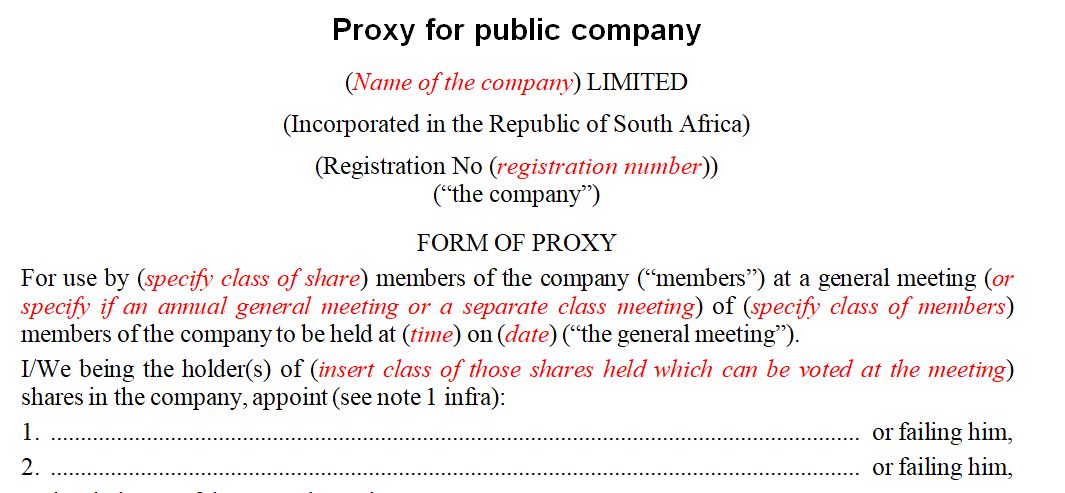
Proxy for Public Company
FREE

Ask the similar questions
Proxy for Public Company
Proxy for Public Company
Directors of public companies play a crucial role in ensuring that a company and its management team serve the interests of its shareholders. Proxy voting can help ensure accountability of management teams and boards of directors, align management and shareholder interests, and monitor and assess the degree of transparency and disclosure with respect to executive compensation and board actions affecting shareholders’ rights.
The following general guidelines are intended to reflect these proxy voting principles:
Under the 1973 Companies Act, a company was entitled to require a proxy to be lodged on or before a particular time, in order for that proxy to be valid. The rationale for this provision was to give sufficient time to enable the officer presiding at a meeting to verify and validate the proxy, before allowing that proxy to vote.
It is common practice for a company to include a provision in its memorandum of incorporation which requires that a proxy form be lodged at least 24 hours prior to a meeting.
Reliance on this provision has meant that a shareholder who is unexpectedly prevented from attending a shareholders meeting through forces beyond its control, is unable to submit a proxy form on the day of meeting, resulting in that shareholder not being entitled to vote at such meeting.
The wording of the Companies Act, 2008 (“the Act”) has changed, and the shareholders of a company is entitled at any time to appoint any individual as a proxy to participate in and speak and vote at a shareholders meeting on behalf of that shareholder.
The Practical Implications
Upon a proper interpretation of the judgment, and the relevant provisions of the Act, the provisions of a company’s MOI which purport to impose a time constraint for the delivery of a proxy form, will be invalid, only to the extent that such provision/s are inconsistent with their shareholders’ right to appoint a proxy at any time before a meeting as provided for the in the Act.
The proxy forms themselves will remain valid and shareholders making use of such forms will not be excluded from any meetings.
The court did recognise the practical difficulties that may arise as a result of this interpretation of s 58, including the administrative burden imposed on the presiding officer of a general meeting to validate and verify proxies prior to allowing a proxy to exercise a vote. The court noted that such practical difficulties need to be resolved through legislative intervention and not through a strained interpretation of the Act.
The ultimate effect of this judgment, therefore, is that shareholders may submit a proxy form “at any time” and the company is not entitled to place any time constraint on such right. Any attempt to enforce such a time constraint will not withstand challenge.
No legislative intervention has been forthcoming to date, and any company which has an MOI which requires a proxy form to be delivered at a specified time prior to a meeting, should consider an amendment to that MOI, and at the very least, should not attempt to enforce such time limitation.
Appointing a proxy
A member of a company is entitled to appoint another person as his proxy to exercise all or any of his rights to attend, speak and vote at a meeting of the company.
In every notice calling a meeting of a company, there must appear, with reasonable emphasis, a statement informing the member of his rights under the Companies Act) to appoint a proxy, and any more extensive rights conferred by the articles to appoint more than one proxy.
A member can appoint any other person to act as his proxy; it does not have to be another shareholder of the company. In practice, where the voting at a general meeting is to be held on a poll rather than a show of hands, many shareholders opt to appoint the chairman of the meeting to be their proxy. They usually set out voting instructions within the proxy form, which the chairman is obliged to follow.
A member of a company is entitled to appoint more than one proxy to exercise all or any of his rights to attend and to speak and vote at a meeting of the company, provided that each proxy is appointed to exercise the rights attached to a different share or shares held by the member. This right cannot be excluded or reduced by a company’s articles of association.
The Companies Act does not specify any particular way in which the members of a non-traded company should appoint a proxy. However, the company's articles of association will usually contain more detail on the appointment of a proxy and should be reviewed prior to doing so.
The Companies Act also does not specify any time by which a proxy notice must be received. However, in practice, companies tend to set a deadline for delivery of proxy notices in their articles of association. A member may terminate his proxy's authority to attend, vote and speak at a general meeting at any given point.
Voting By Proxy
In order to pass a shareholder resolution at a general meeting (including an AGM), the members of a company will have to vote on the resolution either on a show of hands, or on a poll.
A proxy must vote in accordance with any voting instructions given by the member by whom the proxy is appointed.
Subject to the provisions of a company's memorandum of incorporation, on a vote on a resolution on a show of hands at a meeting, every proxy present who has been duly appointed by one or more members entitled to vote on the resolution has one vote, and a proxy has one vote for and one vote against the resolution if:
• the proxy has been duly appointed by more than one member entitled to vote on the resolution, and
• the proxy has been instructed by one or more of those members to vote for the resolution and by one or more other of those members to vote against it.
Many companies now generally use poll voting rather than voting on a show of hands. On a poll, all or any of the voting rights of a member may be exercised by one or more duly appointed proxies, but where more than one proxy is appointed, those proxies are not authorised to exercise more extensive voting rights than could have been exercised by the member in person. This reflects the fact that multiple proxies can only be appointed and exercise rights in respect of different shares.
Directors of public companies play a crucial role in ensuring that a company and its management team serve the interests of its shareholders. Proxy voting can help ensure accountability of management teams and boards of directors, align management and shareholder interests, and monitor and assess the degree of transparency and disclosure with respect to executive compensation and board actions affecting shareholders’ rights.
The following general guidelines are intended to reflect these proxy voting principles:
Under the 1973 Companies Act, a company was entitled to require a proxy to be lodged on or before a particular time, in order for that proxy to be valid. The rationale for this provision was to give sufficient time to enable the officer presiding at a meeting to verify and validate the proxy, before allowing that proxy to vote.
It is common practice for a company to include a provision in its memorandum of incorporation which requires that a proxy form be lodged at least 24 hours prior to a meeting.
Reliance on this provision has meant that a shareholder who is unexpectedly prevented from attending a shareholders meeting through forces beyond its control, is unable to submit a proxy form on the day of meeting, resulting in that shareholder not being entitled to vote at such meeting.
The wording of the Companies Act, 2008 (“the Act”) has changed, and the shareholders of a company is entitled at any time to appoint any individual as a proxy to participate in and speak and vote at a shareholders meeting on behalf of that shareholder.
The Practical Implications
Upon a proper interpretation of the judgment, and the relevant provisions of the Act, the provisions of a company’s MOI which purport to impose a time constraint for the delivery of a proxy form, will be invalid, only to the extent that such provision/s are inconsistent with their shareholders’ right to appoint a proxy at any time before a meeting as provided for the in the Act.
The proxy forms themselves will remain valid and shareholders making use of such forms will not be excluded from any meetings.
The court did recognise the practical difficulties that may arise as a result of this interpretation of s 58, including the administrative burden imposed on the presiding officer of a general meeting to validate and verify proxies prior to allowing a proxy to exercise a vote. The court noted that such practical difficulties need to be resolved through legislative intervention and not through a strained interpretation of the Act.
The ultimate effect of this judgment, therefore, is that shareholders may submit a proxy form “at any time” and the company is not entitled to place any time constraint on such right. Any attempt to enforce such a time constraint will not withstand challenge.
No legislative intervention has been forthcoming to date, and any company which has an MOI which requires a proxy form to be delivered at a specified time prior to a meeting, should consider an amendment to that MOI, and at the very least, should not attempt to enforce such time limitation.
Appointing a proxy
A member of a company is entitled to appoint another person as his proxy to exercise all or any of his rights to attend, speak and vote at a meeting of the company.
In every notice calling a meeting of a company, there must appear, with reasonable emphasis, a statement informing the member of his rights under the Companies Act) to appoint a proxy, and any more extensive rights conferred by the articles to appoint more than one proxy.
A member can appoint any other person to act as his proxy; it does not have to be another shareholder of the company. In practice, where the voting at a general meeting is to be held on a poll rather than a show of hands, many shareholders opt to appoint the chairman of the meeting to be their proxy. They usually set out voting instructions within the proxy form, which the chairman is obliged to follow.
A member of a company is entitled to appoint more than one proxy to exercise all or any of his rights to attend and to speak and vote at a meeting of the company, provided that each proxy is appointed to exercise the rights attached to a different share or shares held by the member. This right cannot be excluded or reduced by a company’s articles of association.
The Companies Act does not specify any particular way in which the members of a non-traded company should appoint a proxy. However, the company's articles of association will usually contain more detail on the appointment of a proxy and should be reviewed prior to doing so.
The Companies Act also does not specify any time by which a proxy notice must be received. However, in practice, companies tend to set a deadline for delivery of proxy notices in their articles of association. A member may terminate his proxy's authority to attend, vote and speak at a general meeting at any given point.
Voting By Proxy
In order to pass a shareholder resolution at a general meeting (including an AGM), the members of a company will have to vote on the resolution either on a show of hands, or on a poll.
A proxy must vote in accordance with any voting instructions given by the member by whom the proxy is appointed.
Subject to the provisions of a company's memorandum of incorporation, on a vote on a resolution on a show of hands at a meeting, every proxy present who has been duly appointed by one or more members entitled to vote on the resolution has one vote, and a proxy has one vote for and one vote against the resolution if:
• the proxy has been duly appointed by more than one member entitled to vote on the resolution, and
• the proxy has been instructed by one or more of those members to vote for the resolution and by one or more other of those members to vote against it.
Many companies now generally use poll voting rather than voting on a show of hands. On a poll, all or any of the voting rights of a member may be exercised by one or more duly appointed proxies, but where more than one proxy is appointed, those proxies are not authorised to exercise more extensive voting rights than could have been exercised by the member in person. This reflects the fact that multiple proxies can only be appointed and exercise rights in respect of different shares.
Legal App FREE Download - We Handle Your Case On The Go