
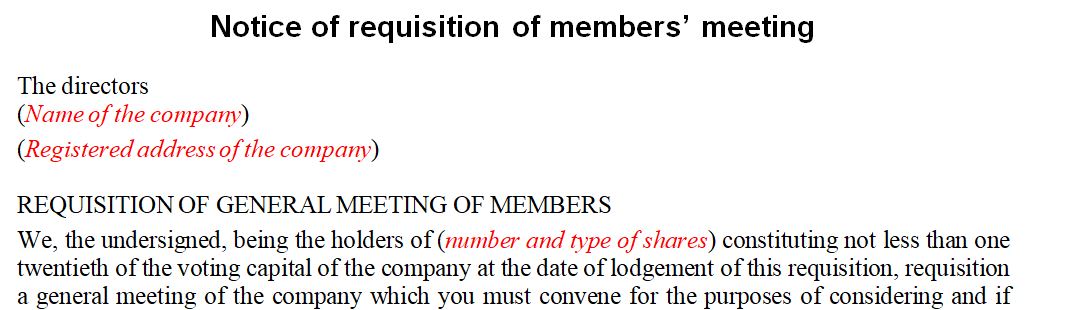
Notice of Requisition of Members Meeting
FREE

Ask the similar questions
Notice of Requisition of Members Meeting
Notice of Requisition of Members Meeting
There is a resolution forcing the directors of a company to take a certain action normally requires a special resolution (passed by 75% of the votes cast), the object of requisitioning a meeting and proposing a resolution is often to remove the directors of the company and replace them with appointees whose views on the management of the company reflect those of the requisitioning shareholders.
A resolution to remove a director using the powers contained in the Companies Act only requires an ordinary resolution (passed by a bare majority of votes cast) and the Company’s Memorandum of Incorporation allow shareholders, provided advance notice is given to the company, to put forward a director and appoint him to the board by ordinary resolution.
A note on members' rights in relation to general meetings, including the right to requisition a meeting, the right to propose a resolution at a public or traded company's AGM and the right to require a company to circulate a statement relating to a resolution or other business to be dealt with at a meeting.
Shareholders can require the directors of a company, subject to the Companies Act, to call a general meeting of its shareholders if they together represent at least 5 percent of the paid-up voting share capital of the company (excluding any voting rights attached to treasury shares). Such a request can be made at any time but must state the general nature of the business to be dealt with at such requisitioned meeting.
It may also include the text of a resolution to be moved at the meeting, so long as it is not defamatory, frivolous or vexatious and so long as it would not be ineffective if passed (whether because of inconsistency with law or the constitutional documents of the company or otherwise).
Mandatory Requirements
1. The Board shall, at the requisition made by:
a. in the case of a company having a share capital, such number of members who hold, on the date of the receipt of the requisition, not less than one-tenth of such of the paid-up share capital of the company as on that date carries the right of voting.
b. in the case of a company not having a share capital, such number of members who have, on the date of receipt of the requisition, not less than one-tenth of the total voting power of all the members having on the said date a right to vote, call an extraordinary general meeting of the company.
2. If the Board does not, within twenty-one days from the date of receipt of a valid requisition in regard to any matter, proceed to call a meeting for the consideration of that matter on a day not later than forty-five days from the date of receipt of such requisition, the meeting may be called and held by the requisitionists themselves within a period of three months from the date of the requisition.
3. Quorum must be present within half-an-hour from the time appointed for holding the meeting otherwise the meeting shall stand cancelled.
The Following Procedure is to be Followed:
A. Board Convening the Requisitioned EGM (extraordinary general meeting):
1. Requisition by Members
a. A requisition for EGM must be:
• In writing or through electronic mode;
• Set out the matters for the consideration of which the meeting is to be called;
• Signed by the requisitionists and sent to the registered office of the Company.
b. Requisition must be signed by the requisitionist himself or through his duly authorized agent. The authorization must be in writing and enclosed with the requisition. And when the requisition is filed through electronic mode, it shall also attach a scan copy of duly signed requisition thereto.
2. Convene a Meeting of Board of Directors
a. When a valid requisition is received, Board shall proceed to call the EGM within 21 days from the date of receipt of the requisition.
b. Issue Notice of Board Meeting to all the Directors of Company at their addresses registered with the Company, at least 7 days before the date of Board Meeting. A shorter notice can be issued in case of urgent business.
c. Attach Agenda, Notes to Agenda and Draft Resolution with the Notice.
d. Hold a meeting of Board of Directors of the Company and pass the necessary Board Resolution:
• to fix day, date, time and venue for holding Extraordinary General Meeting of the Company. The meeting must be held with 45 days from the date of receipt of valid requisition.
• to approve the draft notice of EGM along with explanatory statement annexed to the notice. If the requisitionists do not specify any explanatory statement, company also need not to annex explanatory statement.
• to authorize the Director or Company Secretary to sign and issue notice of the EGM and to do such acts, deeds and things as may be necessary to give effect to the Board’s decision.
e. Prepare and Circulate Draft Minutes within 15 days from the conclusion of the Board Meeting, by Hand/Speed Post/Registered Post/Courier/E-mail to all the Directors for their comments. [Refer the Procedure for Preparation and Signing of Minutes of Board Meeting].
B. The power to requisition an EGM and propose resolutions is most often used in connection with a takeover offer for the company. For example, shareholders who would welcome an offer may use the power to remove directors who they believe are seeking to frustrate or prevent an offer.
The power is also sometimes used when a bidder has acquired over 50% of the voting rights following a takeover, but the company's directors refuse to resign and are thought to be taking decisions which are contrary to the interests of the majority shareholder.
C. Irrespective of anything in the company's MOI, the shareholders may at any time remove any director by an ordinary resolution. The person(s) proposing the resolution must notify the company at least 28 days before the date of the meeting.
D. Unless the AGM happens to be imminent, this power will be used in conjunction with the power to requisition an EGM, and the requisitioning shareholders will specify that the objects of the meeting are the removal of the existing directors.
• The requisitioning shareholders may also use their right to require the company to circulate a statement explaining why they want the director(s) replaced.
• Any director who is the subject of a resolution to remove him from office has the right to protest his removal by making written 'representations', which the company must circulate to shareholders, and by speaking at the meeting where the resolution is considered.
There is a resolution forcing the directors of a company to take a certain action normally requires a special resolution (passed by 75% of the votes cast), the object of requisitioning a meeting and proposing a resolution is often to remove the directors of the company and replace them with appointees whose views on the management of the company reflect those of the requisitioning shareholders.
A resolution to remove a director using the powers contained in the Companies Act only requires an ordinary resolution (passed by a bare majority of votes cast) and the Company’s Memorandum of Incorporation allow shareholders, provided advance notice is given to the company, to put forward a director and appoint him to the board by ordinary resolution.
A note on members' rights in relation to general meetings, including the right to requisition a meeting, the right to propose a resolution at a public or traded company's AGM and the right to require a company to circulate a statement relating to a resolution or other business to be dealt with at a meeting.
Shareholders can require the directors of a company, subject to the Companies Act, to call a general meeting of its shareholders if they together represent at least 5 percent of the paid-up voting share capital of the company (excluding any voting rights attached to treasury shares). Such a request can be made at any time but must state the general nature of the business to be dealt with at such requisitioned meeting.
It may also include the text of a resolution to be moved at the meeting, so long as it is not defamatory, frivolous or vexatious and so long as it would not be ineffective if passed (whether because of inconsistency with law or the constitutional documents of the company or otherwise).
Mandatory Requirements
1. The Board shall, at the requisition made by:
a. in the case of a company having a share capital, such number of members who hold, on the date of the receipt of the requisition, not less than one-tenth of such of the paid-up share capital of the company as on that date carries the right of voting.
b. in the case of a company not having a share capital, such number of members who have, on the date of receipt of the requisition, not less than one-tenth of the total voting power of all the members having on the said date a right to vote, call an extraordinary general meeting of the company.
2. If the Board does not, within twenty-one days from the date of receipt of a valid requisition in regard to any matter, proceed to call a meeting for the consideration of that matter on a day not later than forty-five days from the date of receipt of such requisition, the meeting may be called and held by the requisitionists themselves within a period of three months from the date of the requisition.
3. Quorum must be present within half-an-hour from the time appointed for holding the meeting otherwise the meeting shall stand cancelled.
The Following Procedure is to be Followed:
A. Board Convening the Requisitioned EGM (extraordinary general meeting):
1. Requisition by Members
a. A requisition for EGM must be:
• In writing or through electronic mode;
• Set out the matters for the consideration of which the meeting is to be called;
• Signed by the requisitionists and sent to the registered office of the Company.
b. Requisition must be signed by the requisitionist himself or through his duly authorized agent. The authorization must be in writing and enclosed with the requisition. And when the requisition is filed through electronic mode, it shall also attach a scan copy of duly signed requisition thereto.
2. Convene a Meeting of Board of Directors
a. When a valid requisition is received, Board shall proceed to call the EGM within 21 days from the date of receipt of the requisition.
b. Issue Notice of Board Meeting to all the Directors of Company at their addresses registered with the Company, at least 7 days before the date of Board Meeting. A shorter notice can be issued in case of urgent business.
c. Attach Agenda, Notes to Agenda and Draft Resolution with the Notice.
d. Hold a meeting of Board of Directors of the Company and pass the necessary Board Resolution:
• to fix day, date, time and venue for holding Extraordinary General Meeting of the Company. The meeting must be held with 45 days from the date of receipt of valid requisition.
• to approve the draft notice of EGM along with explanatory statement annexed to the notice. If the requisitionists do not specify any explanatory statement, company also need not to annex explanatory statement.
• to authorize the Director or Company Secretary to sign and issue notice of the EGM and to do such acts, deeds and things as may be necessary to give effect to the Board’s decision.
e. Prepare and Circulate Draft Minutes within 15 days from the conclusion of the Board Meeting, by Hand/Speed Post/Registered Post/Courier/E-mail to all the Directors for their comments. [Refer the Procedure for Preparation and Signing of Minutes of Board Meeting].
B. The power to requisition an EGM and propose resolutions is most often used in connection with a takeover offer for the company. For example, shareholders who would welcome an offer may use the power to remove directors who they believe are seeking to frustrate or prevent an offer.
The power is also sometimes used when a bidder has acquired over 50% of the voting rights following a takeover, but the company's directors refuse to resign and are thought to be taking decisions which are contrary to the interests of the majority shareholder.
C. Irrespective of anything in the company's MOI, the shareholders may at any time remove any director by an ordinary resolution. The person(s) proposing the resolution must notify the company at least 28 days before the date of the meeting.
D. Unless the AGM happens to be imminent, this power will be used in conjunction with the power to requisition an EGM, and the requisitioning shareholders will specify that the objects of the meeting are the removal of the existing directors.
• The requisitioning shareholders may also use their right to require the company to circulate a statement explaining why they want the director(s) replaced.
• Any director who is the subject of a resolution to remove him from office has the right to protest his removal by making written 'representations', which the company must circulate to shareholders, and by speaking at the meeting where the resolution is considered.
Legal App FREE Download - We Handle Your Case On The Go