
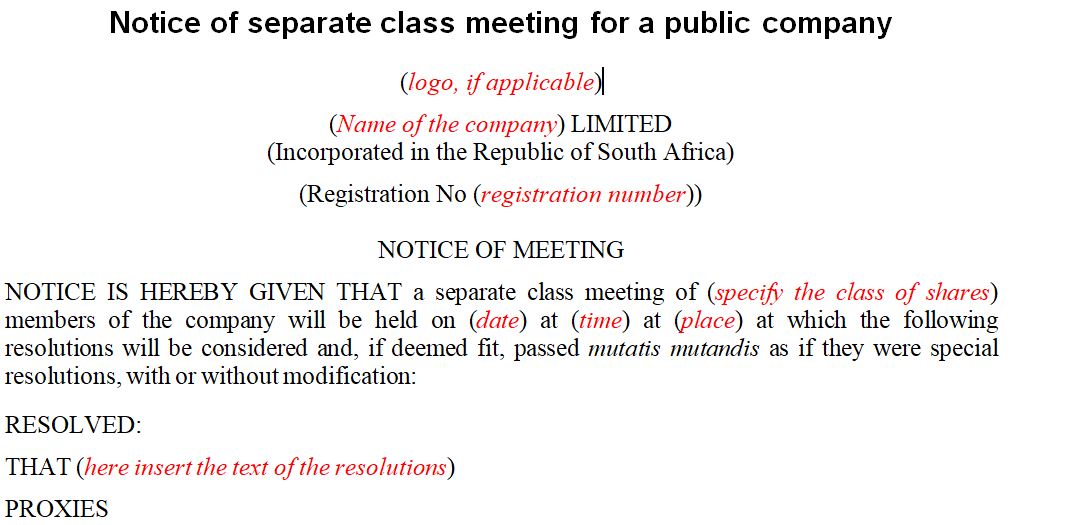
Notice of Separate Class Meeting for Public Company
FREE

Ask the similar questions
Notice of Separate Class Meeting for Public Company
Notice of Separate Class Meeting for Public Company
A general meeting is a meeting of the shareholders of a company that can be held at any time in order to pass decisions that the law requires all of the shareholders’ approval for or where a meeting of the shareholders is desired by the company or its board, or the shareholders themselves.
A class meeting, by comparison, is a meeting of some of the company’s shareholders that are part of a particular class of shares and that is held because the law (usually the Companies Act) or a company’s Memorandum of Incorporation requires them to make a decision. This could be to exercise some of the rights particular to that class, or where the company wants to vary the rights of the class.
A company’s memorandum of incorporation or a shareholders’ agreement between the shareholders of the company will usually set out the rights attached to classes of shares.
Classes of shares will usually have different names and it is common to see shares referred to as ‘ordinary shares’ (these are usually the ‘base’ shares of the company) or ‘preference shares’ or to be given different letters (‘A Shares’, ‘B Shares’) to differentiate between the different classes, but the name alone cannot be the only differentiator between classes – the types of shares and rights attached to those shares need to be different too.
It is important before making or trying to pass any decisions to ensure that all necessary consents have been considered in the planning of meetings and general operational timetables. If a company does not have any shares (such as a company limited by guarantee) it can still have different classes of members in a similar way to companies with classes of shares.
Class meetings are usually held separately from general meetings. The procedure is likely to follow that for a general meeting, but check the company’s MOI or the document that sets out the rights attached to the class of shares in question in case it differs. The Companies Act applies the general meeting rules as regards:
• the notice of the meeting;
• quorum requirements;
• the chairman of the meeting;
• proxies and corporate representatives; and
• shareholders’ ability to circulate statements about the matters to be considered at the meeting.
If the meeting has been called to vary class rights, the quorum for the meeting is at least two shareholders who hold at least one third of the nominal value of the issued shares of the class in question. If the meeting has to be adjourned, it will be quorate if at least one person in the class attends.
On a resolution to vary class rights, any member of the relevant class can demand a poll vote. Even if a class does not usually have the right to vote, if the resolution concerns a variation of their rights they are entitled to vote. For further information, see our Variation of Class Rights Checklist and Special Resolution.
Notice
Notice must be given to all members of the relevant class at least 14 clear days in advance of the meeting.
Meeting during the pandemic
Holding in-person meetings during the coronavirus pandemic has been difficult either because of national or local restrictions or because doing so would put participants at risk. Many companies can successfully hold meetings online. However, some cannot do so under their MOI or for practical reasons such as shareholder numbers, access to the necessary technology, or willingness to meet remotely.
Written resolutions can be used in many cases, but private companies may have to hold a meeting because they are obliged to do so under their articles or they need to comply with a statutory procedure (and public companies are still obliged to hold AGMs).
Shareholders do not have a right to attend the meeting or participate in any way other than voting. This effectively converts the requirement to hold a meeting into a written resolution, still giving shareholders the right to participate in the decision, without having to meet in person and without the company having to manage discussions remotely.
These temporary measures override any provisions in the company’s articles that deal with shareholder meetings and apply to any type of meeting, including class meetings. The Notice of Class Meeting has been amended to include this method of holding meetings. Companies should attach the text of the resolutions to be considered.
Whether a class meeting is required will depend on the decision to be considered. The company’s memorandum of incorporation or the shareholders’ agreement may include a set of reserved matters that require the explicit consent of a particular class of shareholders or members.
This is a good way for minority shareholders to have a veto and therefore protection of their rights in the event of a decision being considered that will fundamentally change the constitution, ownership or operation of the company or that may affect or repeal the rights attached to the shares in their class.
Shareholders who are named on a company’s register of members may attend and speak at meetings. At a class meeting, only the shareholders in that class may speak and only matters involving that class of shares may be discussed – any other matters involving the wider shareholder body need to be discussed at a general meeting of shareholders.
If more than one person holds the shares, then all holders can attend and speak but only the person named first on the register of members will be entitled to vote. Proxies of shareholders are also permitted to attend and speak. The company’s directors and auditors can also attend and speak at a class meeting.
Shareholders voting at a class meeting can vote on a decision in two ways – on a show of hands or by poll voting. The difference between the two methods of voting is the way that the votes are counted. If shareholders vote on a show of hands, the votes of the shareholders present at the meeting are counted.
The result will be declared by the chairman of the meeting and this declaration will usually be considered final and binding. Shareholders can attend in person, or can appoint a proxy or corporate representative to represent them. When a decision is voted by a poll then the votes are counted based on the number of shares that each shareholder that is attending (whether themselves, or by proxy or corporate representative) the meeting owns.
With poll voting, a member does not have to vote all their shares in the same way.
A general meeting is a meeting of the shareholders of a company that can be held at any time in order to pass decisions that the law requires all of the shareholders’ approval for or where a meeting of the shareholders is desired by the company or its board, or the shareholders themselves.
A class meeting, by comparison, is a meeting of some of the company’s shareholders that are part of a particular class of shares and that is held because the law (usually the Companies Act) or a company’s Memorandum of Incorporation requires them to make a decision. This could be to exercise some of the rights particular to that class, or where the company wants to vary the rights of the class.
A company’s memorandum of incorporation or a shareholders’ agreement between the shareholders of the company will usually set out the rights attached to classes of shares.
Classes of shares will usually have different names and it is common to see shares referred to as ‘ordinary shares’ (these are usually the ‘base’ shares of the company) or ‘preference shares’ or to be given different letters (‘A Shares’, ‘B Shares’) to differentiate between the different classes, but the name alone cannot be the only differentiator between classes – the types of shares and rights attached to those shares need to be different too.
It is important before making or trying to pass any decisions to ensure that all necessary consents have been considered in the planning of meetings and general operational timetables. If a company does not have any shares (such as a company limited by guarantee) it can still have different classes of members in a similar way to companies with classes of shares.
Class meetings are usually held separately from general meetings. The procedure is likely to follow that for a general meeting, but check the company’s MOI or the document that sets out the rights attached to the class of shares in question in case it differs. The Companies Act applies the general meeting rules as regards:
• the notice of the meeting;
• quorum requirements;
• the chairman of the meeting;
• proxies and corporate representatives; and
• shareholders’ ability to circulate statements about the matters to be considered at the meeting.
If the meeting has been called to vary class rights, the quorum for the meeting is at least two shareholders who hold at least one third of the nominal value of the issued shares of the class in question. If the meeting has to be adjourned, it will be quorate if at least one person in the class attends.
On a resolution to vary class rights, any member of the relevant class can demand a poll vote. Even if a class does not usually have the right to vote, if the resolution concerns a variation of their rights they are entitled to vote. For further information, see our Variation of Class Rights Checklist and Special Resolution.
Notice
Notice must be given to all members of the relevant class at least 14 clear days in advance of the meeting.
Meeting during the pandemic
Holding in-person meetings during the coronavirus pandemic has been difficult either because of national or local restrictions or because doing so would put participants at risk. Many companies can successfully hold meetings online. However, some cannot do so under their MOI or for practical reasons such as shareholder numbers, access to the necessary technology, or willingness to meet remotely.
Written resolutions can be used in many cases, but private companies may have to hold a meeting because they are obliged to do so under their articles or they need to comply with a statutory procedure (and public companies are still obliged to hold AGMs).
Shareholders do not have a right to attend the meeting or participate in any way other than voting. This effectively converts the requirement to hold a meeting into a written resolution, still giving shareholders the right to participate in the decision, without having to meet in person and without the company having to manage discussions remotely.
These temporary measures override any provisions in the company’s articles that deal with shareholder meetings and apply to any type of meeting, including class meetings. The Notice of Class Meeting has been amended to include this method of holding meetings. Companies should attach the text of the resolutions to be considered.
Whether a class meeting is required will depend on the decision to be considered. The company’s memorandum of incorporation or the shareholders’ agreement may include a set of reserved matters that require the explicit consent of a particular class of shareholders or members.
This is a good way for minority shareholders to have a veto and therefore protection of their rights in the event of a decision being considered that will fundamentally change the constitution, ownership or operation of the company or that may affect or repeal the rights attached to the shares in their class.
Shareholders who are named on a company’s register of members may attend and speak at meetings. At a class meeting, only the shareholders in that class may speak and only matters involving that class of shares may be discussed – any other matters involving the wider shareholder body need to be discussed at a general meeting of shareholders.
If more than one person holds the shares, then all holders can attend and speak but only the person named first on the register of members will be entitled to vote. Proxies of shareholders are also permitted to attend and speak. The company’s directors and auditors can also attend and speak at a class meeting.
Shareholders voting at a class meeting can vote on a decision in two ways – on a show of hands or by poll voting. The difference between the two methods of voting is the way that the votes are counted. If shareholders vote on a show of hands, the votes of the shareholders present at the meeting are counted.
The result will be declared by the chairman of the meeting and this declaration will usually be considered final and binding. Shareholders can attend in person, or can appoint a proxy or corporate representative to represent them. When a decision is voted by a poll then the votes are counted based on the number of shares that each shareholder that is attending (whether themselves, or by proxy or corporate representative) the meeting owns.
With poll voting, a member does not have to vote all their shares in the same way.
Legal App FREE Download - We Handle Your Case On The Go