
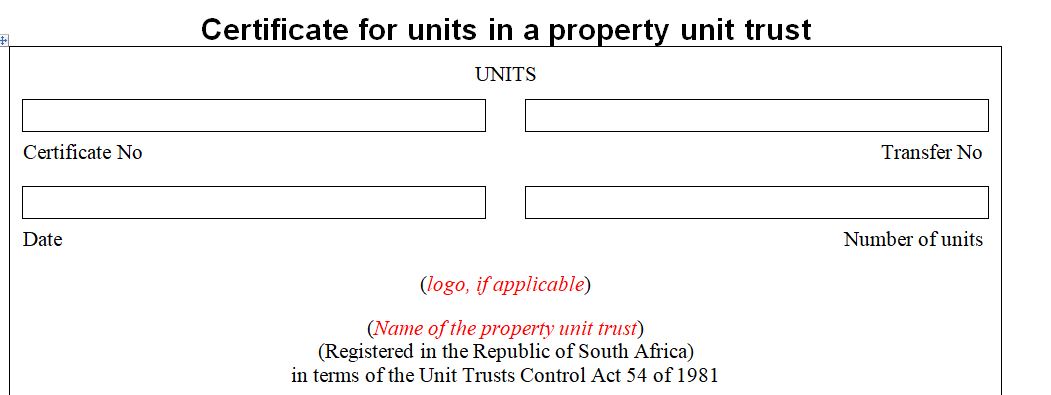
Certificate for Units in a Property Unit Trust
FREE

Ask the similar questions
Certificate for Units in a Property Unit Trust
Certificate for Units in a Property Unit Trust
Certificate for Units in a Property Unit Trust
To simplify this title a unit trust is an arrangement whereby property is held on trust for a large number of investors. It is constituted by a deed regulating the rights, powers and duties of the parties to the arrangement. These parties are usually a manager, a trustee and investors, the last being commonly known as unit holders.
The manager purchases property and vests the title to it in the trustee who, at the outset, holds on trust for the manager. Sometimes, the property is an estate in land or a mortgage thereof but most unit trusts- are in respect of a portfolio of shares. In the ensuing discussion the former will be called a land-unit trust and the latter a share unit trust.
The beneficial interest is divided into a large number of units which are sold by the manager to investors. Share- unit trusts are of two kinds: fixed and flexible. In the fixed unit trust the portfolio of shares is fixed and not, except in special circumstances, subject to variation.
The first portfolio of investments in a fixed unit trust is described as a unit and the beneficial interest is divided into sub-units which the manager sells to investors. A fixed unit trust deed will usually provide for the constitution of additional units matching the first portfolio which will be vested in the trustee and divided into the same number of sub- units. In the flexible unit trust the manager and the trustee have power under the deed to vary the nature and proportions of the shares comprising the trust fund.
The manager agrees to buy back units from any unit holder desiring to sell. These units may be resold by the manager. The trust deed will usually provide that the trust is to come to an end at a fixed date and one of several modes of dissolution will operate: the property may be realised and the proceeds distributed amongst the unit holders, the trust may be converted into an investment company or, if the property admits of division in specie, it may be so divided between unit holders.
The idea of vesting property in a trustee for a large number of investors is not new. The unincorporated trading company was organised in such a way that the property of the company was held by trustees for the benefit of the investors on the terms of a deed of settlement which prescribed the rights, duties and powers of the members of the trading company.
If you invest in a unit trust or fund, your money is pooled with money from other investors and invested in a portfolio of assets according to the fund’s stated investment objective and investment approach.
A unit trust is a fund which adopts a trust structure; not all funds use a trust structure. In this guide, the term “fund” will also refer to a unit trust.
Unit trusts versus ILPs
Investment-linked insurance policies (ILPs) are another way to invest in funds. The difference between these and unit trusts is that ILPs combine life insurance coverage and investment components. Your premiums are used to pay for units in sub-funds of your choice, and some of the units are then sold to pay for insurance and other charges.
If your main goal is investment, you may wish to consider unit trusts. Sometimes, the ILP sub-fund that you are interested in may also be offered as a unit trust (i.e. without insurance coverage).
Returns from unit trusts
You invest in a fund by buying units in the fund. There is a capital gain when the price of the units rises above the price you paid for the fund. Some funds pay dividends.
The price of each unit is based on the fund’s net asset value (NAV) divided by the number of units outstanding. The NAV of a fund is the market value of the fund’s net assets (investments, cash and other assets minus expenses, payables and other liabilities.) The NAV is usually computed daily to reflect changes in the prices of the investments held by the fund.
Funds are not principal or capital-guaranteed
You may lose a substantial amount of the money you invested in certain situations. The risks of investing in the fund are described in the product offering documents such as the prospectus and the product highlights sheet.
Fees can also reduce your returns
Regardless of how well or poorly the fund performs, even if your fund’s value has been fairly stable, the fees you pay will, over time, reduce the value of your investment.
Why invest in funds?
Funds invest in a diversified range of assets. A fund’s diversified portfolio means risks can be better spread over the assets in the fund. Investing in funds may not be for everyone. Before you invest, make sure that you:
• Want potentially higher returns but are also prepared for variable returns which include the risk of losing a substantial part of your investment
• Understand how returns are calculated or the factors that can affect returns.
Understand the fund’s investment objective, strategy or approach.
•
• Are familiar with the fund manager and fund’s track record.
•
• Understand the risks associated with the fund.
•
• o Some funds use financial derivatives for hedging or investment purposes. You should be aware of the risks associated with the use of financial derivatives, including the risk that the provider (or counterparty) of the financial derivatives defaults.
Are prepared to have your money tied up for long periods of time.
• o As funds are exposed to market ups and downs, investors who stay invested long enough may be better able to ride out the downturns.
o You should have adequate financial resources so that you won’t have to liquidate your funds during a market downturn. If you need to convert your investments to cash in the short- term to meet specific needs, some funds may not be suitable for you.
Types of funds
• There are different types of funds available, each with its own investment objective and investment approach or strategy.
• The investment objective may be capital appreciation or to generate income. The fund manager decides the fund’s investment strategy (to achieve the investment objective) and what assets to buy or sell.
• Funds with the same investment objective may use different investment strategies to achieve the same goal. You should ensure that the fund manager’s investment style is in line with your own investment objectives.
When choosing a fund, consider the following:
• what assets it invests in;
• investment strategy or approach;
• risk and return profile;
• passive or active management;
• if you change your mind: right to cancel;
• you can change your mind about your fund purchase within 7 calendar days;
• there will not be any administrative penalty for cancelling your purchase but you may suffer a loss if the fund has fallen in market value after you bought it;
• if the market value of the fund has risen, you will get a full refund of what you paid for the fund, but you will not be entitled to the gain. in either case, the sales charge will be refunded to you.
What are the risks
Some of the risks associated with investing in unit trusts include the following:
Market risk The fund’s NAV or trading prices will be affected by changes in the value of the assets in the fund that in turn are affected by changing economic, political or market conditions.
Liquidity risk There is no secondary market for funds that are not listed. Hence, you can only redeem your units on the fund’s dealing days.
The secondary market may also be illiquid for funds that are listed and traded on a securities exchange. This may affect the prices at which you buy or sell.
Interest rate risk Funds that invest in bonds, debentures or other debt securities will be exposed to interest rate movements because the prices of debt securities tend to move in an opposite direction to interest rates. For instance, debt securities prices generally fall when interest rates rise.
Foreign currency or foreign exchange risk Funds that invest in assets denominated in foreign currencies may be exposed to adverse currency movements. The fund’s currency base may also be different from your own.
Counterparty risk Funds may be exposed to the risk that the counterparty that they trade with is unable to meet its payment obligations due to a deterioration of the counterparty’s financial situation or otherwise.
How a unit is priced
The way a unit in a unit trust is priced is a simple equation: The assets of the unit trust are the shares, bonds, cash and/or property that the unit trust owns on behalf of investors. The value of these assets is generally updated daily, but sometimes weekly, depending on the unit trust. The operating expenses comprise fund management fees, operating costs – which include trustee and custodian fees, audit fees or their service fee, and bank charges – transactional costs for buying and selling shares, and VAT. Once operating expenses are subtracted from assets, this sum is then divided by the total number of units bought by investors.
Certificate for Units in a Property Unit Trust
To simplify this title a unit trust is an arrangement whereby property is held on trust for a large number of investors. It is constituted by a deed regulating the rights, powers and duties of the parties to the arrangement. These parties are usually a manager, a trustee and investors, the last being commonly known as unit holders.
The manager purchases property and vests the title to it in the trustee who, at the outset, holds on trust for the manager. Sometimes, the property is an estate in land or a mortgage thereof but most unit trusts- are in respect of a portfolio of shares. In the ensuing discussion the former will be called a land-unit trust and the latter a share unit trust.
The beneficial interest is divided into a large number of units which are sold by the manager to investors. Share- unit trusts are of two kinds: fixed and flexible. In the fixed unit trust the portfolio of shares is fixed and not, except in special circumstances, subject to variation.
The first portfolio of investments in a fixed unit trust is described as a unit and the beneficial interest is divided into sub-units which the manager sells to investors. A fixed unit trust deed will usually provide for the constitution of additional units matching the first portfolio which will be vested in the trustee and divided into the same number of sub- units. In the flexible unit trust the manager and the trustee have power under the deed to vary the nature and proportions of the shares comprising the trust fund.
The manager agrees to buy back units from any unit holder desiring to sell. These units may be resold by the manager. The trust deed will usually provide that the trust is to come to an end at a fixed date and one of several modes of dissolution will operate: the property may be realised and the proceeds distributed amongst the unit holders, the trust may be converted into an investment company or, if the property admits of division in specie, it may be so divided between unit holders.
The idea of vesting property in a trustee for a large number of investors is not new. The unincorporated trading company was organised in such a way that the property of the company was held by trustees for the benefit of the investors on the terms of a deed of settlement which prescribed the rights, duties and powers of the members of the trading company.
If you invest in a unit trust or fund, your money is pooled with money from other investors and invested in a portfolio of assets according to the fund’s stated investment objective and investment approach.
A unit trust is a fund which adopts a trust structure; not all funds use a trust structure. In this guide, the term “fund” will also refer to a unit trust.
Unit trusts versus ILPs
Investment-linked insurance policies (ILPs) are another way to invest in funds. The difference between these and unit trusts is that ILPs combine life insurance coverage and investment components. Your premiums are used to pay for units in sub-funds of your choice, and some of the units are then sold to pay for insurance and other charges.
If your main goal is investment, you may wish to consider unit trusts. Sometimes, the ILP sub-fund that you are interested in may also be offered as a unit trust (i.e. without insurance coverage).
Returns from unit trusts
You invest in a fund by buying units in the fund. There is a capital gain when the price of the units rises above the price you paid for the fund. Some funds pay dividends.
The price of each unit is based on the fund’s net asset value (NAV) divided by the number of units outstanding. The NAV of a fund is the market value of the fund’s net assets (investments, cash and other assets minus expenses, payables and other liabilities.) The NAV is usually computed daily to reflect changes in the prices of the investments held by the fund.
Funds are not principal or capital-guaranteed
You may lose a substantial amount of the money you invested in certain situations. The risks of investing in the fund are described in the product offering documents such as the prospectus and the product highlights sheet.
Fees can also reduce your returns
Regardless of how well or poorly the fund performs, even if your fund’s value has been fairly stable, the fees you pay will, over time, reduce the value of your investment.
Why invest in funds?
Funds invest in a diversified range of assets. A fund’s diversified portfolio means risks can be better spread over the assets in the fund. Investing in funds may not be for everyone. Before you invest, make sure that you:
• Want potentially higher returns but are also prepared for variable returns which include the risk of losing a substantial part of your investment
• Understand how returns are calculated or the factors that can affect returns.
Understand the fund’s investment objective, strategy or approach.
•
• Are familiar with the fund manager and fund’s track record.
•
• Understand the risks associated with the fund.
•
• o Some funds use financial derivatives for hedging or investment purposes. You should be aware of the risks associated with the use of financial derivatives, including the risk that the provider (or counterparty) of the financial derivatives defaults.
Are prepared to have your money tied up for long periods of time.
• o As funds are exposed to market ups and downs, investors who stay invested long enough may be better able to ride out the downturns.
o You should have adequate financial resources so that you won’t have to liquidate your funds during a market downturn. If you need to convert your investments to cash in the short- term to meet specific needs, some funds may not be suitable for you.
Types of funds
• There are different types of funds available, each with its own investment objective and investment approach or strategy.
• The investment objective may be capital appreciation or to generate income. The fund manager decides the fund’s investment strategy (to achieve the investment objective) and what assets to buy or sell.
• Funds with the same investment objective may use different investment strategies to achieve the same goal. You should ensure that the fund manager’s investment style is in line with your own investment objectives.
When choosing a fund, consider the following:
• what assets it invests in;
• investment strategy or approach;
• risk and return profile;
• passive or active management;
• if you change your mind: right to cancel;
• you can change your mind about your fund purchase within 7 calendar days;
• there will not be any administrative penalty for cancelling your purchase but you may suffer a loss if the fund has fallen in market value after you bought it;
• if the market value of the fund has risen, you will get a full refund of what you paid for the fund, but you will not be entitled to the gain. in either case, the sales charge will be refunded to you.
What are the risks
Some of the risks associated with investing in unit trusts include the following:
Market risk The fund’s NAV or trading prices will be affected by changes in the value of the assets in the fund that in turn are affected by changing economic, political or market conditions.
Liquidity risk There is no secondary market for funds that are not listed. Hence, you can only redeem your units on the fund’s dealing days.
The secondary market may also be illiquid for funds that are listed and traded on a securities exchange. This may affect the prices at which you buy or sell.
Interest rate risk Funds that invest in bonds, debentures or other debt securities will be exposed to interest rate movements because the prices of debt securities tend to move in an opposite direction to interest rates. For instance, debt securities prices generally fall when interest rates rise.
Foreign currency or foreign exchange risk Funds that invest in assets denominated in foreign currencies may be exposed to adverse currency movements. The fund’s currency base may also be different from your own.
Counterparty risk Funds may be exposed to the risk that the counterparty that they trade with is unable to meet its payment obligations due to a deterioration of the counterparty’s financial situation or otherwise.
How a unit is priced
The way a unit in a unit trust is priced is a simple equation: The assets of the unit trust are the shares, bonds, cash and/or property that the unit trust owns on behalf of investors. The value of these assets is generally updated daily, but sometimes weekly, depending on the unit trust. The operating expenses comprise fund management fees, operating costs – which include trustee and custodian fees, audit fees or their service fee, and bank charges – transactional costs for buying and selling shares, and VAT. Once operating expenses are subtracted from assets, this sum is then divided by the total number of units bought by investors.
Legal App FREE Download - We Handle Your Case On The Go