
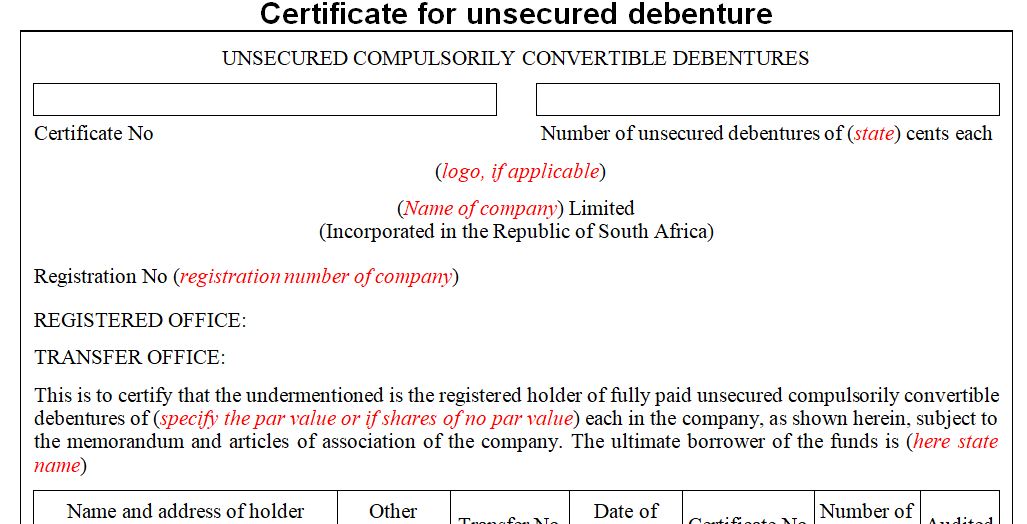
Certificate for unsecured debenture
FREE

Ask the similar questions
Certificate for unsecured debenture
Certificate for Unsecured Debenture
A debenture is a loan agreement in writing between a borrower and a lender that is registered with CIPC. It gives the lender security over the borrower’s assets.
Typically, a debenture is used by a bank, factoring company or invoice discounter to take security for their loans. A debenture can only be taken on a limited company or limited liability partnership, it cannot be taken over a sole trader or standard partnership.
A director who has advanced or lent money into their own company could take a debenture to secure the loan. A private lender can also take a debenture.
How does a debenture holder enforce their security?
The lender (debenture holder) has the right to appoint an administrator to take control of the company if it defaults on the loan. This follows the lender calling in the loan for repayment.
The threat of appointing an administrator can often be enough to make a company repay the debt, or agree terms to repay it.
How does the debenture holder get their money back if the company becomes insolvent?
The administrator or liquidator must hand over assets caught by the debenture to the lender. Usually, the lender agrees for the administrator or liquidator to sell the assets for them for a fee.
Assets can fall into a fixed or floating charge category caught by the debenture.
Normally, the types of assets caught by a fixed charge are: book debts under a factoring agreement, freehold or leasehold property, and plant and machinery fixed to the floor.
Floating charge assets are items not caught by the fixed charge of the debenture, and are typically movable assets such as trading stock, equipment, furniture and computers.
The Companies Act, 2008
In terms of the Companies Act, a “debenture” includes debenture stock, debenture bonds, common notes and any other debt security of a company but does not include promissory notes and loans, whether constituting a charge on the assets of the company or not. This definition gives more certainty to what is presently an imprecise definition of “debenture” under the Companies Act.
A company may create and issue debentures except in instances where its Memorandum of Incorporation provides otherwise. This is a new concept, in contrast to that contained in the Companies Act, which requires a company to create and issue debentures only if it is allowed under its MOI.
The Act further introduces a new concept via a “debenture document”, which includes “any document by which a debenture is offered or enabled, embodying the terms and conditions of the debenture, including but not limited to a trust deed or certificate”. It will no longer be necessary to issue debenture certificates or to issue debentures in terms of a trust deed. In order to validly issue debentures, any document may be used, provided that the terms and conditions of the debentures are contained in it.
Under the Act, a debenture document need no longer state whether a debenture is “secured” or “unsecured”, as was previously required under the old Companies Act. The new Act does, however, prohibit the expression of debenture as “secured” in a debenture document unless such a debenture meets the set requirements for a “secured” debenture.
The Act specifically provides that “secured” debentures must be secured to a “substantial extent” by a direct specific mortgage on freehold or long leasehold property or other immovable property or any other fixed assets that meet any requirements contained in the debenture document. Debentures secured by movable property do not constitute “secured” debentures under the specifications set out in the Act.
The new Act does not preclude the issue of debentures secured by movable property; it only precludes such debentures from being referred to as “secured” debentures – a principle that contrasts with the old Companies Act, which provides for the manner in which movable property may be bound as security for a debenture (for example, a deed of pledge, notarial bond, surety bond, and so on).
A debenture document may provide that debentures be issued at different times, as determined by the company. However, each debenture, whenever issued, ranks in preference concurrently with all other debentures at the date on which the debenture document was registered or constituted.
The Companies Act has a similar provision, except that the provisions in the Companies Act relate only to bonds or pledges that have been executed in favour of the trustee for debenture holders. The Act allows for the board of directors of a company to determine the terms and consideration or other benefit for which the debentures will be issued. The determination of the board of directors as to the “adequacy” of the consideration or other “benefit” for the debentures may only be challenged on the grounds of a breach of directors’ fiduciary duties.
Although “benefit” is not defined in the Act, it may be interpreted as a type of security or payment made in return for the issue of a debenture.
Once a company has received the benefit approved by the board of directors, the debentures are seen to be fully paid up. Hence, the company is obliged to issue the debentures and enter the name of the debenture holder on the company’s securities register. The Companies Act requires a separate register for debenture holders.
The Companies Act recognises that debenture holders may place their debentures in trust. The trustees for debenture holders may not be a director or officer of the company and must not have any interest in or relationship with the company which may conflict with their position as trustee.
The Act prescribes that a trustee must be a “corporation” or individual of “standing and repute”.
Another fresh concept contained in the Act is that the appointment of a new trustee must be approved by 75% of debenture holders at a general meeting; a provision designed to protect “minority” debenture holders.
it is important to note that any provision in a trust deed for the securing of an issue of debentures is void to the extent that it exempts or indemnifies a trustee against liability for breach of trust or “failure to exercise the degree of care and skill required of a prudent and careful person”.
Be that as it may, the Act states that any provision enabling a release with the consent of 75% in value of debenture holders present and voting at a meeting called for this purpose and with respect to a specific act or omission is valid.
Provisions relating to the protection of creditors, the issue of debentures with special privileges, and conversion rights are new concepts in the regulation of debentures. In order to protect creditors against the voluntary liquidation of a company, the Act prohibits the provision for payment of an amount less than the face value and the premium due at the time (a specified date or on notice) in instances where a debenture is repayable at a premium determined at a fixed or variable rate.
The Act allows for debentures to be issued with special privileges relating to the allotment of securities, attending and voting at general meetings and the appointment of directors. These special privileges are allowed provided they are in a manner and form stipulated in the Memorandum of Incorporation and are approved by way of special resolution of all shareholders’ present at a general meeting convened to approve such resolution.
A debenture is a loan agreement in writing between a borrower and a lender that is registered with CIPC. It gives the lender security over the borrower’s assets.
Typically, a debenture is used by a bank, factoring company or invoice discounter to take security for their loans. A debenture can only be taken on a limited company or limited liability partnership, it cannot be taken over a sole trader or standard partnership.
A director who has advanced or lent money into their own company could take a debenture to secure the loan. A private lender can also take a debenture.
How does a debenture holder enforce their security?
The lender (debenture holder) has the right to appoint an administrator to take control of the company if it defaults on the loan. This follows the lender calling in the loan for repayment.
The threat of appointing an administrator can often be enough to make a company repay the debt, or agree terms to repay it.
How does the debenture holder get their money back if the company becomes insolvent?
The administrator or liquidator must hand over assets caught by the debenture to the lender. Usually, the lender agrees for the administrator or liquidator to sell the assets for them for a fee.
Assets can fall into a fixed or floating charge category caught by the debenture.
Normally, the types of assets caught by a fixed charge are: book debts under a factoring agreement, freehold or leasehold property, and plant and machinery fixed to the floor.
Floating charge assets are items not caught by the fixed charge of the debenture, and are typically movable assets such as trading stock, equipment, furniture and computers.
The Companies Act, 2008
In terms of the Companies Act, a “debenture” includes debenture stock, debenture bonds, common notes and any other debt security of a company but does not include promissory notes and loans, whether constituting a charge on the assets of the company or not. This definition gives more certainty to what is presently an imprecise definition of “debenture” under the Companies Act.
A company may create and issue debentures except in instances where its Memorandum of Incorporation provides otherwise. This is a new concept, in contrast to that contained in the Companies Act, which requires a company to create and issue debentures only if it is allowed under its MOI.
The Act further introduces a new concept via a “debenture document”, which includes “any document by which a debenture is offered or enabled, embodying the terms and conditions of the debenture, including but not limited to a trust deed or certificate”. It will no longer be necessary to issue debenture certificates or to issue debentures in terms of a trust deed. In order to validly issue debentures, any document may be used, provided that the terms and conditions of the debentures are contained in it.
Under the Act, a debenture document need no longer state whether a debenture is “secured” or “unsecured”, as was previously required under the old Companies Act. The new Act does, however, prohibit the expression of debenture as “secured” in a debenture document unless such a debenture meets the set requirements for a “secured” debenture.
The Act specifically provides that “secured” debentures must be secured to a “substantial extent” by a direct specific mortgage on freehold or long leasehold property or other immovable property or any other fixed assets that meet any requirements contained in the debenture document. Debentures secured by movable property do not constitute “secured” debentures under the specifications set out in the Act.
The new Act does not preclude the issue of debentures secured by movable property; it only precludes such debentures from being referred to as “secured” debentures – a principle that contrasts with the old Companies Act, which provides for the manner in which movable property may be bound as security for a debenture (for example, a deed of pledge, notarial bond, surety bond, and so on).
A debenture document may provide that debentures be issued at different times, as determined by the company. However, each debenture, whenever issued, ranks in preference concurrently with all other debentures at the date on which the debenture document was registered or constituted.
The Companies Act has a similar provision, except that the provisions in the Companies Act relate only to bonds or pledges that have been executed in favour of the trustee for debenture holders. The Act allows for the board of directors of a company to determine the terms and consideration or other benefit for which the debentures will be issued. The determination of the board of directors as to the “adequacy” of the consideration or other “benefit” for the debentures may only be challenged on the grounds of a breach of directors’ fiduciary duties.
Although “benefit” is not defined in the Act, it may be interpreted as a type of security or payment made in return for the issue of a debenture.
Once a company has received the benefit approved by the board of directors, the debentures are seen to be fully paid up. Hence, the company is obliged to issue the debentures and enter the name of the debenture holder on the company’s securities register. The Companies Act requires a separate register for debenture holders.
The Companies Act recognises that debenture holders may place their debentures in trust. The trustees for debenture holders may not be a director or officer of the company and must not have any interest in or relationship with the company which may conflict with their position as trustee.
The Act prescribes that a trustee must be a “corporation” or individual of “standing and repute”.
Another fresh concept contained in the Act is that the appointment of a new trustee must be approved by 75% of debenture holders at a general meeting; a provision designed to protect “minority” debenture holders.
it is important to note that any provision in a trust deed for the securing of an issue of debentures is void to the extent that it exempts or indemnifies a trustee against liability for breach of trust or “failure to exercise the degree of care and skill required of a prudent and careful person”.
Be that as it may, the Act states that any provision enabling a release with the consent of 75% in value of debenture holders present and voting at a meeting called for this purpose and with respect to a specific act or omission is valid.
Provisions relating to the protection of creditors, the issue of debentures with special privileges, and conversion rights are new concepts in the regulation of debentures. In order to protect creditors against the voluntary liquidation of a company, the Act prohibits the provision for payment of an amount less than the face value and the premium due at the time (a specified date or on notice) in instances where a debenture is repayable at a premium determined at a fixed or variable rate.
The Act allows for debentures to be issued with special privileges relating to the allotment of securities, attending and voting at general meetings and the appointment of directors. These special privileges are allowed provided they are in a manner and form stipulated in the Memorandum of Incorporation and are approved by way of special resolution of all shareholders’ present at a general meeting convened to approve such resolution.
Legal App FREE Download - We Handle Your Case On The Go