
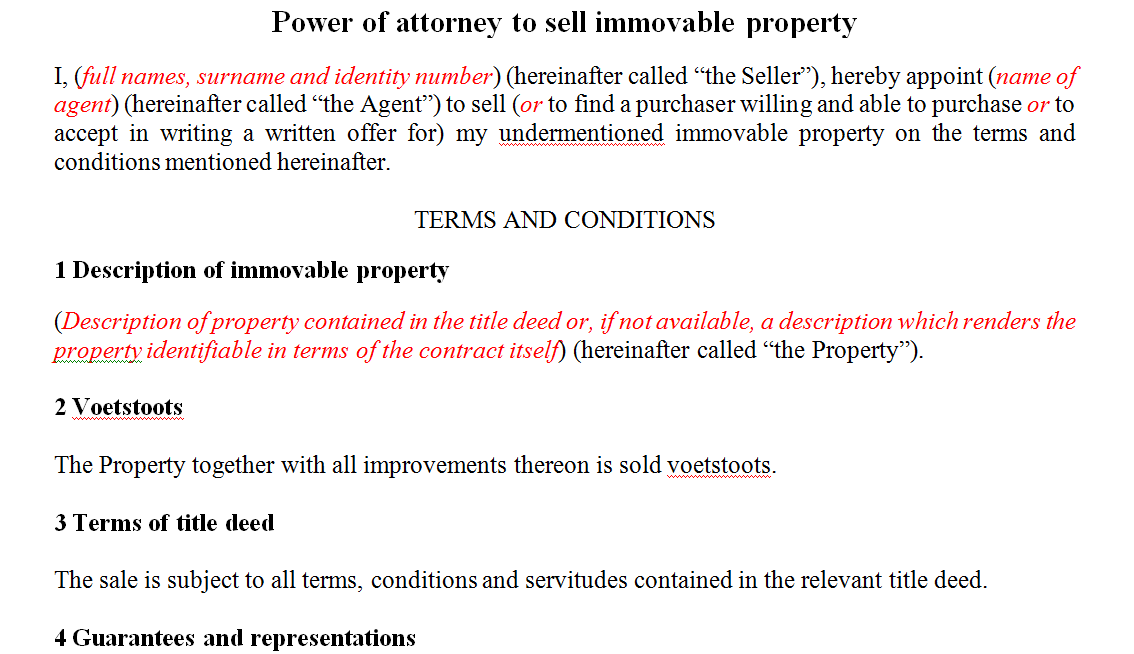
Power of attorney to sell immovable property
FREE

Ask the similar questions
Power of attorney to sell immovable property
Power of Attorney to Sell Immovable Property
Power of attorney empowering an agent to sell immovable property and setting out the details of the property, risk, occupation thereof, etc.
It is often necessary to give someone authorisation to act on someone else’s behalf when that someone (the grantor) is out of the country or temporarily unable to manage his or her affairs. This document is referred to as a Power of Attorney.
A General Power of Attorney is by its very nature, used for the same purpose the name implies. It confers general powers from the grantor to the grantee to perform and carry out various legal acts on behalf of the grantor. A special power of attorney on the other hand, serves a specific purpose in that it grants very limited and concise powers to the grantee. In other words, it relates to a specific act or acts and nothing else.
For property transactions, the originally signed Power of Attorney must be lodged in the Deeds Office together with the transfer documents (if the seller gave Power of Attorney) or bond documents (if the purchaser gave someone else Power of Attorney.)
A General Power of Attorney can also be registered in the Deeds Office which can then be used for future property transactions where the seller is selling. It is important to note that a General Power of Attorney must be drafted with some degree of caution due to the wide variety of powers it confers from grantor to grantee.
In order for a Power of Attorney to be valid, it must clearly describe and identify the grantor and grantee as well as the extent of the power conferred upon the grantee.
It must be signed by the grantor and two witnesses and will remain valid until such time as it is revoked, when the mandate is completed or where the agent or grantor passed away, is sequestrated or becomes mentally unfit. This highlights the most common misconception regarding powers of attorney: A power of attorney is no longer valid when the grantor is not lucid.
Furthermore, the persons signing as witnesses cannot derive any benefit from the Power of Attorney. It is also important to bear in mind that banks generally do not accept Powers of Attorney other than their own special documentation for purposes of financial transactions.
The Use of The Power of Attorney in Immovable Property Transactions
The seller’s circumstances should be assessed to determine whether a General Power of Attorney or a Special Power of Attorney is required.
An example where the use of a Special Power of Attorney would be appropriate would be where the parties intend on emigrating and one spouse will depart from South Africa prior to sale or registration of the immovable property or where one of the sellers is generally unavailable. In such cases sellers can be advised to have a General Power of Attorney/Special Power of Attorney drafted which would enable a trusted party in South Africa or one of the remaining co-owner/s to sign the necessary sale and transfer documents.
The reason for this requirement is that when transfer documents are to be signed outside of South Africa the deeds registry has various requirements such as that the documents need to be signed at a South African embassy or a foreign notary in which case an authentication process may be required using an Apostille certificate.
The aforementioned are often impractical, time consuming and expensive, thus the alternative of a special power of attorney proves advantageous.
General
The use of a Power of Attorney in the deeds registry must comply with the requirements of the Deeds Registries Act. In this regard the Power of Attorney must properly and comprehensively describe the grantor, the grantee and the immovable property in question. There are also requirements specific to a General Power of Attorney or a Special Power of Attorney which must be complied with.
The Power of Attorney must further contain a “preparation certificate” where a qualified conveyancer signs the document and accepts responsibility for the correctness of the contents thereof. It is for this reason when drafting a General Power of Attorney or a Special Power of Attorney that a conveyancer be consulted in order to ensure the Power of Attorney is correctly drafted so as to avoid same being rejected by the deeds registry and being unusable.
Validity of Powers of Attorney
A Power of Attorney is only valid for so long as the grantor has the power to revoke same. In other words if the grantor is incapable of revoking the Power of Attorney due to being, for example, unconscious or mentally incapable, that Power of Attorney may no longer be used.
Under such circumstances the grantee would be obliged to wait until the grantor is rendered capable or the grantee would have to approach a court for the appointment of a curator bonis to look after the affairs of the grantor.
Grantees should further bear in mind that a Power of Attorney is not a tool to be used to achieve something that the grantor does not wish to be done. The grantee must act in accordance with the grantor’s instructions and according to his wishes.
General Power of Attorney
A General Power of Attorney does not need to be registered in the deeds registry when used for general purposes. When the General Power of Attorney is used for the transfer of immovable property however, the Registrar of Deeds will require the General Power of Attorney to be lodged and registered in the deeds registry before or simultaneously with the transfer of the property sold.
Once registered, the General Power of Attorney will be allocated a GPA number which can be used for future reference, that is, when using the same General Power of Attorney for future property transactions in the same deeds registry. If the General Power of Attorney is to be used in another deeds registry a Regulation 65 copy must be obtained and registered.
Special Power of Attorney
This is the most common and prudent Power of Attorney used for conveyancing purposes. A Special Power of Attorney grants limited powers to the grantee for a specific purpose.
An example would be an Special Power of Attorney which authorizes the grantee to market for sale a particular property, to accept a purchase price (a minimum purchase price must be stipulated), and to sign all conveyancing documentation to effect the transfer of the property sold.
It is furthermore prudent to note the following with regard to powers of attorney signed in one country for use in another. Powers of attorney and affidavits signed outside South Africa for use in South Africa must be authenticated as set out in Rule 63 of the High Court; or as stated in the “Hague Convention Abolishing the Requirement of Legalisation for Foreign Public Documents” (The Convention).
Rule 63 provides that any document executed in any country other than South Africa is deemed to be sufficiently authenticated for use in the Republic if it has been duly authenticated by means of a certificate attached to the document, at such foreign place by the signature and official seal of the South African Embassy.
Power of attorney empowering an agent to sell immovable property and setting out the details of the property, risk, occupation thereof, etc.
It is often necessary to give someone authorisation to act on someone else’s behalf when that someone (the grantor) is out of the country or temporarily unable to manage his or her affairs. This document is referred to as a Power of Attorney.
A General Power of Attorney is by its very nature, used for the same purpose the name implies. It confers general powers from the grantor to the grantee to perform and carry out various legal acts on behalf of the grantor. A special power of attorney on the other hand, serves a specific purpose in that it grants very limited and concise powers to the grantee. In other words, it relates to a specific act or acts and nothing else.
For property transactions, the originally signed Power of Attorney must be lodged in the Deeds Office together with the transfer documents (if the seller gave Power of Attorney) or bond documents (if the purchaser gave someone else Power of Attorney.)
A General Power of Attorney can also be registered in the Deeds Office which can then be used for future property transactions where the seller is selling. It is important to note that a General Power of Attorney must be drafted with some degree of caution due to the wide variety of powers it confers from grantor to grantee.
In order for a Power of Attorney to be valid, it must clearly describe and identify the grantor and grantee as well as the extent of the power conferred upon the grantee.
It must be signed by the grantor and two witnesses and will remain valid until such time as it is revoked, when the mandate is completed or where the agent or grantor passed away, is sequestrated or becomes mentally unfit. This highlights the most common misconception regarding powers of attorney: A power of attorney is no longer valid when the grantor is not lucid.
Furthermore, the persons signing as witnesses cannot derive any benefit from the Power of Attorney. It is also important to bear in mind that banks generally do not accept Powers of Attorney other than their own special documentation for purposes of financial transactions.
The Use of The Power of Attorney in Immovable Property Transactions
The seller’s circumstances should be assessed to determine whether a General Power of Attorney or a Special Power of Attorney is required.
An example where the use of a Special Power of Attorney would be appropriate would be where the parties intend on emigrating and one spouse will depart from South Africa prior to sale or registration of the immovable property or where one of the sellers is generally unavailable. In such cases sellers can be advised to have a General Power of Attorney/Special Power of Attorney drafted which would enable a trusted party in South Africa or one of the remaining co-owner/s to sign the necessary sale and transfer documents.
The reason for this requirement is that when transfer documents are to be signed outside of South Africa the deeds registry has various requirements such as that the documents need to be signed at a South African embassy or a foreign notary in which case an authentication process may be required using an Apostille certificate.
The aforementioned are often impractical, time consuming and expensive, thus the alternative of a special power of attorney proves advantageous.
General
The use of a Power of Attorney in the deeds registry must comply with the requirements of the Deeds Registries Act. In this regard the Power of Attorney must properly and comprehensively describe the grantor, the grantee and the immovable property in question. There are also requirements specific to a General Power of Attorney or a Special Power of Attorney which must be complied with.
The Power of Attorney must further contain a “preparation certificate” where a qualified conveyancer signs the document and accepts responsibility for the correctness of the contents thereof. It is for this reason when drafting a General Power of Attorney or a Special Power of Attorney that a conveyancer be consulted in order to ensure the Power of Attorney is correctly drafted so as to avoid same being rejected by the deeds registry and being unusable.
Validity of Powers of Attorney
A Power of Attorney is only valid for so long as the grantor has the power to revoke same. In other words if the grantor is incapable of revoking the Power of Attorney due to being, for example, unconscious or mentally incapable, that Power of Attorney may no longer be used.
Under such circumstances the grantee would be obliged to wait until the grantor is rendered capable or the grantee would have to approach a court for the appointment of a curator bonis to look after the affairs of the grantor.
Grantees should further bear in mind that a Power of Attorney is not a tool to be used to achieve something that the grantor does not wish to be done. The grantee must act in accordance with the grantor’s instructions and according to his wishes.
General Power of Attorney
A General Power of Attorney does not need to be registered in the deeds registry when used for general purposes. When the General Power of Attorney is used for the transfer of immovable property however, the Registrar of Deeds will require the General Power of Attorney to be lodged and registered in the deeds registry before or simultaneously with the transfer of the property sold.
Once registered, the General Power of Attorney will be allocated a GPA number which can be used for future reference, that is, when using the same General Power of Attorney for future property transactions in the same deeds registry. If the General Power of Attorney is to be used in another deeds registry a Regulation 65 copy must be obtained and registered.
Special Power of Attorney
This is the most common and prudent Power of Attorney used for conveyancing purposes. A Special Power of Attorney grants limited powers to the grantee for a specific purpose.
An example would be an Special Power of Attorney which authorizes the grantee to market for sale a particular property, to accept a purchase price (a minimum purchase price must be stipulated), and to sign all conveyancing documentation to effect the transfer of the property sold.
It is furthermore prudent to note the following with regard to powers of attorney signed in one country for use in another. Powers of attorney and affidavits signed outside South Africa for use in South Africa must be authenticated as set out in Rule 63 of the High Court; or as stated in the “Hague Convention Abolishing the Requirement of Legalisation for Foreign Public Documents” (The Convention).
Rule 63 provides that any document executed in any country other than South Africa is deemed to be sufficiently authenticated for use in the Republic if it has been duly authenticated by means of a certificate attached to the document, at such foreign place by the signature and official seal of the South African Embassy.
Legal App FREE Download - We Handle Your Case On The Go