
Assignment of rights and obligations by a principal under an agency agreement
FREE

Ask the similar questions
Assignment of rights and obligations by a principal under an agency agreement
Assignment of Rights and Obligations by a Principal Under an Agency Agreement
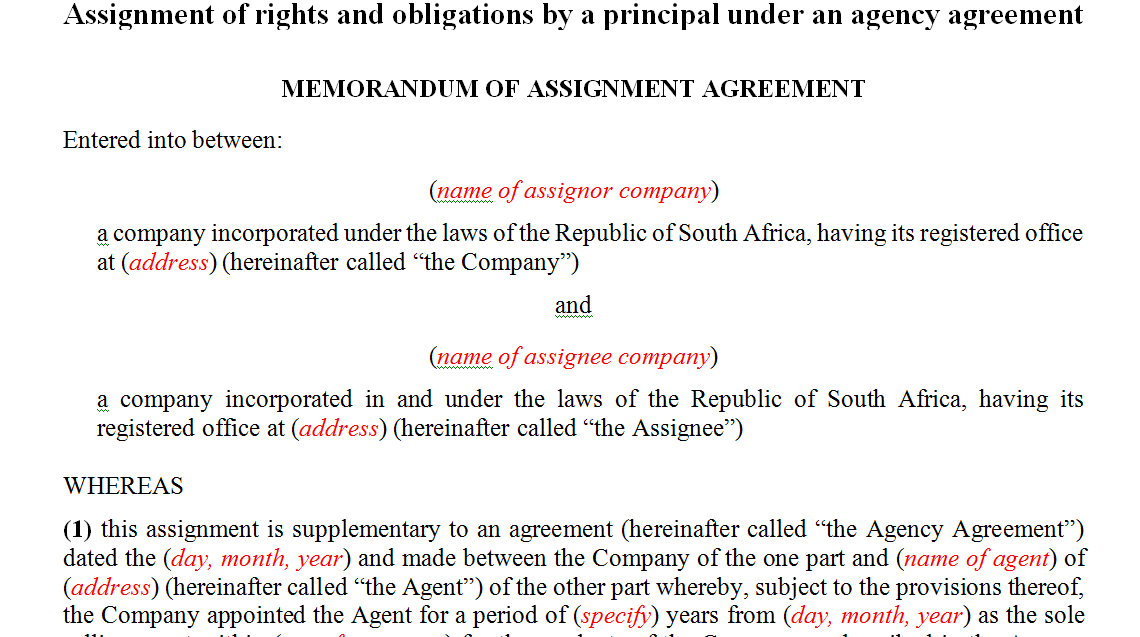
Memorandum of assignment agreement between two companies which is a supplementary to an agreement concluded between the companies earlier whereby the company assigns rights and duties to the asignee company.
The agent owes the principal two categories of duties: fiduciary and general. The fiduciary duty is the duty to always act in the interest of the principal. The general duty owed by the agent encompasses the types of obligations any employee might have, this includes the duty of skill and care, good conduct, to keep and render accounts, to not attempt anything impossible or impracticable, to obey, and to give information.
The principal in turn also owes the agent certain duties in terms of the agreement. These duties include: warning the agent of hazards associated with the job, to avoid interfering with the agent’s performance of his job, to render accounts of money due the agent, and to indemnify the agent for business expenses according to their agreement.
The obligations of an agent
The agent to an agreement has the following residual obligations:
• to do what he or she has been instructed to do;
• to exercise care, skill and diligence;
• to impart information to the principal;
• not to disclose private information to third parties;
• to advise the principal;
• to act in good faith; and
• to account to the principal.
The duties of an agent depend primarily on the contract of agency. The above residual duties will be discussed below.
Duty to perform the mandate
An agent is under a duty to perform his mandate fully and faithfully. If he fails to do so, he not only forfeits his commission but also becomes liable in damages to his principal. Generally, an agent may not delegate his authority to another agent. Delegation is only allowed where the principal has allowed it, either expressly or impliedly.
Duty to obey instructions
An agent must act strictly in accordance with the instructions of his principal so long as they are lawful and reasonable. He has no discretion to disobey them even if he honestly and reasonably regards them not to be in the best interests of the principal. An agent is not liable for any loss his principal may incur as a result of carrying out his principal’s instructions. If, however, the agent fails to carry out the instructions, he is liable for any loss suffered by the principal.
Duty to exercise care, skill and diligence
An agent must take reasonable care in carrying out his instructions and must display such skill as may be reasonably expected.
Duty to account
The agent must record all transactions, payments, expenses and receipts in connection with the execution of his authority in order to give a proper account to the principal. The principal is entitled to inspect the records held by the agent.
Duty not to disclose information
If during the execution of his authority an agent acquires secret information concerning his principal he may not disclose it to third parties. He may also not use such knowledge for his own purposes, either at the time of the execution of the authority or at any time thereafter.
Duty to act in good faith
There is a relationship of good faith between the parties. An agent must at all time act in the exclusive interest of his principal and he may not act in a manner that a conflict arises between his own interests and the execution of his authority.
The agent is thus not allowed to make any secret profits in the performance of his duties. If such unforeseen profits do materialise, he must hand them over to his principal. The agent is only entitled to the compensation as agreed upon, unless the principal gave him permission to make additional profits or otherwise renounced his right to such profits. The prejudiced principal is entitled to terminate the authority and to claim damages.
The duty to act in good faith further entails that an agent may not accept a bribe in the execution of his assignment. If the agent accepts a bribe, then even if the principal suffers no loss, he is entitled to dismiss the agent, recover the bribe, or his actual loss (whichever is greater) from the agent and deny commission to the agent and repudiate any resulting transaction.
The obligations of the principal
The principal’s residual obligations are:
• to pay the agreed remuneration, if any;
• to account; and
• if the agent is a mandatory, to indemnify the agent in certain instances.
The duties of a principal depend primarily on the contract of agency. The above residual duties will be discussed below.
Compensation
A principal is obliged to compensate an agent the amount agreed upon and stated in the Agency Agreement.
Render accounts
A principal is obliged to render accounts of monies due to the agent. A principal’s obligation to do so depends on a variety of factors, including: the degree of independence of the agent, the method of compensation, and the customs of the particular business. An agent’s reputation is no less valuable than a principal’s, and so an agent is under no obligation to continue working for one who damages it.
Duty to indemnify
Agents commonly spend money pursuing the principal’s business. Unless the agreement explicitly provides otherwise, the principal has a duty to indemnify or reimburse the agent.
Memorandum of assignment agreement between two companies which is a supplementary to an agreement concluded between the companies earlier whereby the company assigns rights and duties to the asignee company.
The agent owes the principal two categories of duties: fiduciary and general. The fiduciary duty is the duty to always act in the interest of the principal. The general duty owed by the agent encompasses the types of obligations any employee might have, this includes the duty of skill and care, good conduct, to keep and render accounts, to not attempt anything impossible or impracticable, to obey, and to give information.
The principal in turn also owes the agent certain duties in terms of the agreement. These duties include: warning the agent of hazards associated with the job, to avoid interfering with the agent’s performance of his job, to render accounts of money due the agent, and to indemnify the agent for business expenses according to their agreement.
The obligations of an agent
The agent to an agreement has the following residual obligations:
• to do what he or she has been instructed to do;
• to exercise care, skill and diligence;
• to impart information to the principal;
• not to disclose private information to third parties;
• to advise the principal;
• to act in good faith; and
• to account to the principal.
The duties of an agent depend primarily on the contract of agency. The above residual duties will be discussed below.
Duty to perform the mandate
An agent is under a duty to perform his mandate fully and faithfully. If he fails to do so, he not only forfeits his commission but also becomes liable in damages to his principal. Generally, an agent may not delegate his authority to another agent. Delegation is only allowed where the principal has allowed it, either expressly or impliedly.
Duty to obey instructions
An agent must act strictly in accordance with the instructions of his principal so long as they are lawful and reasonable. He has no discretion to disobey them even if he honestly and reasonably regards them not to be in the best interests of the principal. An agent is not liable for any loss his principal may incur as a result of carrying out his principal’s instructions. If, however, the agent fails to carry out the instructions, he is liable for any loss suffered by the principal.
Duty to exercise care, skill and diligence
An agent must take reasonable care in carrying out his instructions and must display such skill as may be reasonably expected.
Duty to account
The agent must record all transactions, payments, expenses and receipts in connection with the execution of his authority in order to give a proper account to the principal. The principal is entitled to inspect the records held by the agent.
Duty not to disclose information
If during the execution of his authority an agent acquires secret information concerning his principal he may not disclose it to third parties. He may also not use such knowledge for his own purposes, either at the time of the execution of the authority or at any time thereafter.
Duty to act in good faith
There is a relationship of good faith between the parties. An agent must at all time act in the exclusive interest of his principal and he may not act in a manner that a conflict arises between his own interests and the execution of his authority.
The agent is thus not allowed to make any secret profits in the performance of his duties. If such unforeseen profits do materialise, he must hand them over to his principal. The agent is only entitled to the compensation as agreed upon, unless the principal gave him permission to make additional profits or otherwise renounced his right to such profits. The prejudiced principal is entitled to terminate the authority and to claim damages.
The duty to act in good faith further entails that an agent may not accept a bribe in the execution of his assignment. If the agent accepts a bribe, then even if the principal suffers no loss, he is entitled to dismiss the agent, recover the bribe, or his actual loss (whichever is greater) from the agent and deny commission to the agent and repudiate any resulting transaction.
The obligations of the principal
The principal’s residual obligations are:
• to pay the agreed remuneration, if any;
• to account; and
• if the agent is a mandatory, to indemnify the agent in certain instances.
The duties of a principal depend primarily on the contract of agency. The above residual duties will be discussed below.
Compensation
A principal is obliged to compensate an agent the amount agreed upon and stated in the Agency Agreement.
Render accounts
A principal is obliged to render accounts of monies due to the agent. A principal’s obligation to do so depends on a variety of factors, including: the degree of independence of the agent, the method of compensation, and the customs of the particular business. An agent’s reputation is no less valuable than a principal’s, and so an agent is under no obligation to continue working for one who damages it.
Duty to indemnify
Agents commonly spend money pursuing the principal’s business. Unless the agreement explicitly provides otherwise, the principal has a duty to indemnify or reimburse the agent.
Legal App FREE Download - We Handle Your Case On The Go