
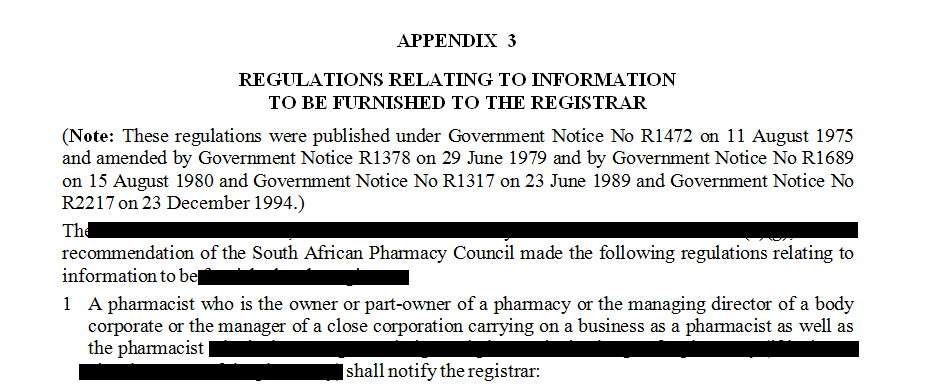
APPENDIX 3 REGULATIONS RELATING TO INFORMATION TO BE FURNISHED TO THE REGISTRAR
FREE

Ask the similar questions
APPENDIX 3 REGULATIONS RELATING TO INFORMATION TO BE FURNISHED TO THE REGISTRAR
Regulations Relating to Information to be Furnished to the Registrar
(South African Pharmacy Council)
In terms of the Good Pharmacy Practice (GPP) of South Africa, pharmacists are required by law to have the following compulsory legislation to comply with the South African Pharmacy Council (SAPC) inspection:
• The Pharmacy Act 53 of 1974;
• Regulations and Rules under the Pharmacy Act 53 of 1974;
• The Medicines and Related Substances Act 101 of 1965;
• Regulations under the Medicines and Related Substances Act 101 of 1965;
• Rules Relating to Good Pharmacy Practice (GPP).
The Pharmacy Act 53 of 1974, Medicines and Related Substances Act 101 of 1965 and Selected Rules & Regulations are all designed to assist pharmacists to comply with these SAPC requirements as stipulated in the GPP.
The vision of the South African Pharmacy Council ('Council'), in serving the public interest and in terms of its statutory obligation, is to ensure that pharmaceutical services are the best to meet the health care needs of the people. The vital element in this vision is the commitment of the pharmacy profession to promote excellence in practice for the benefit of those they serve.
The public and other professions will judge the pharmacy profession on how that commitment is translated into the practice they observe.
The education and training of pharmacists in South Africa must equip them for the roles they have to undertake in practice and be in line with the unit standards for entry-level pharmacists accepted by Council.
Within the necessary basis of pharmaceutical sciences there must thus be adequate emphasis on the action and uses of medicines, a reasonable introduction to disease states and the relevant elements of the social and behavioural sciences. At all stages, the development and improvement of communication skills should be given due emphasis.
All practising pharmacists are obliged to ensure that the service they provide is of high quality and complies with Good Pharmacy Practice Standards as published by Council in rules.
This document (Good Pharmacy Practice in South Africa) indicates how that obligation can be met. Good Pharmacy Practice is obligatory in terms of section 35A of the Pharmacy Act 53 of 1974, as amended ('the Pharmacy Act'), regulation 20(1) of the Regulations Relating to the Practice of Pharmacy, and regulation 7(a) of the Regulations Relating to the Ownership and Licensing of Pharmacies published in terms of the Pharmacy Act as well as regulation 18(7)(b) of the General Regulations published in terms of the Medicines and Related Substances Act 101 of 1965, as amended (the 'Medicines Act').
Licensing of Pharmacies
Unsurprisingly, the only type of premises capable of being adequately licensed for the purpose of lawfully facilitating the acts specially and generally pertaining to the profession of a pharmacist, is a pharmacy.
In this regard, regulation 99 of the Regulations Relating to the Registration of Persons and the Maintenance of Registers (“the Registration Regulations”) provide for five different categories of pharmacy, namely, manufacturing, wholesale, community, institutional and consultant pharmacies.
However, community and institutional pharmacies are the only types of pharmacies at which a pharmacist may dispense or sell medicines to the general public.
The essential difference between community and institutional pharmacies is their location. Community pharmacies can only be established in areas from which they satisfy a collective need expressed by a particular community for access to pharmaceutical products.
Institutional pharmacies, however, can only be established in either public or private health facilities such hospitals, clinics, or community healthcare centres.
Manufacturing pharmacies on the other hand may handle APIs, manufacture medicines, and apply for the registration of medicines.
Wholesale pharmacies are tasked with the distribution of medicines exclusively to institutional and community pharmacies.
Consultant pharmacies advise people regarding the effectiveness and safety of medicines, treatment and therapies and engage in pharmaceutical research and development.
With respect to who may own any kind of pharmacy, readers are advised to consult sections 22(1) and 22A of the Pharmacy Act read with the Regulations Relating to the Ownership and Licensing of Pharmacies (“the Licensing Regulations”).
Registration of Pharmacy
Once a pharmacy has been licensed, it must then be registered by the Pharmacy Council. Naturally, a pharmacy will be registered as a company before such time as it is granted.
With specific regard to the structure of a company which obtains a licence to carry on the business of a pharmacy, regulations 47 and 48 of the Registration Regulations provide that a pharmacist must be appointed, designated and registered as managing director of such company, that a natural person must be appointed and registered to act as nominee in respect such company and that the company itself must also be registered as a pharmacy.
In particular, regulation 48 also provides a that company, which intends to carry on the business of a pharmacy, must submit a number of specified documents to the Registrar of the Pharmacy Council (“the Registrar”).
• The company must submit the following information to the registrar:
(a) a duly completed application on a form approved and provided by the council for the registration of:
(i) the company as a company entitled to carry on the business of a pharmacist;
(ii) the managing director; and
(iii) the nominee;
(b) a certified copy of its certificate of incorporation, memorandum and articles of association in terms of the Companies Act, 1973, which complies with regulation 49, if applicable;
(c) the latest CM22 and CM29 forms submitted to the Registrar of Companies, an acknowledgement of receipt thereof by the Registrar of Companies and an extract from the register of members kept in terms of section 105 of the Companies Act, 1973;
(e) an undertaking in writing that the company will comply with good pharmacy practice as published by council in rules;
(f) the name of the category of pharmacy in which the company wishes to carry on the business of a pharmacist.
• Pay the registration fees as determined by the council.
• An applicant, in terms of regulation 48, who wishes to carry on the business of a retail pharmacy or at any time after its registration carries on the business of a retail pharmacy, must include a clause in its Articles of Association which prohibits the alienation or disposal or transfer of its shares or any direct or indirect beneficial interest in such company to any person not entitled to conduct a retail pharmacy or derive a direct or indirect financial benefit from conducting such pharmacy business.
Such person must be a pharmacist who resides in the Republic of South Africa and a director of the company.
The natural person appointed and registered as such by a company or a close corporation entitled to carry on the business of a pharmacist in terms of the Act and who shall be responsible for the duties as prescribed in regulation 24 of the Regulations Relating to the Practice of Pharmacy.
Regulation 50 of the Registration Regulations further provides that every company which complies with the Registration Regulations and sections 22 and 22A of the Pharmacy Act must be registered as a company entitled to carry on the business of a pharmacy and issued with a registration certificate by the Registrar, indicating the category of pharmacy in which it may carry on such business.
The South African Department of Health (DOH) will have responsibility for the licensing of pharmacies. All persons wanting to own a pharmacy, including registered pharmacists, must apply for a licence. By having control of pharmacy licensing, the DOH hope to obtain a more rational distribution of pharmacies.
It appears there is unlikely to be any guarantee that, should a pharmacist wish to sell an existing business, a licence will be transferred to a new owner. It will depend on whether the DOH finds it favourable. One point the DOH is likely to consider is the sitting of the existing pharmacy.
The South African Pharmacy Council will continue to have responsibility for the registration of pharmacists. This includes maintaining acceptable standards in pharmaceutical education and pharmacy practice. With regard to pharmacy premises, the pharmacy council's role will be limited to inspection and record keeping only.
(South African Pharmacy Council)
In terms of the Good Pharmacy Practice (GPP) of South Africa, pharmacists are required by law to have the following compulsory legislation to comply with the South African Pharmacy Council (SAPC) inspection:
• The Pharmacy Act 53 of 1974;
• Regulations and Rules under the Pharmacy Act 53 of 1974;
• The Medicines and Related Substances Act 101 of 1965;
• Regulations under the Medicines and Related Substances Act 101 of 1965;
• Rules Relating to Good Pharmacy Practice (GPP).
The Pharmacy Act 53 of 1974, Medicines and Related Substances Act 101 of 1965 and Selected Rules & Regulations are all designed to assist pharmacists to comply with these SAPC requirements as stipulated in the GPP.
The vision of the South African Pharmacy Council ('Council'), in serving the public interest and in terms of its statutory obligation, is to ensure that pharmaceutical services are the best to meet the health care needs of the people. The vital element in this vision is the commitment of the pharmacy profession to promote excellence in practice for the benefit of those they serve.
The public and other professions will judge the pharmacy profession on how that commitment is translated into the practice they observe.
The education and training of pharmacists in South Africa must equip them for the roles they have to undertake in practice and be in line with the unit standards for entry-level pharmacists accepted by Council.
Within the necessary basis of pharmaceutical sciences there must thus be adequate emphasis on the action and uses of medicines, a reasonable introduction to disease states and the relevant elements of the social and behavioural sciences. At all stages, the development and improvement of communication skills should be given due emphasis.
All practising pharmacists are obliged to ensure that the service they provide is of high quality and complies with Good Pharmacy Practice Standards as published by Council in rules.
This document (Good Pharmacy Practice in South Africa) indicates how that obligation can be met. Good Pharmacy Practice is obligatory in terms of section 35A of the Pharmacy Act 53 of 1974, as amended ('the Pharmacy Act'), regulation 20(1) of the Regulations Relating to the Practice of Pharmacy, and regulation 7(a) of the Regulations Relating to the Ownership and Licensing of Pharmacies published in terms of the Pharmacy Act as well as regulation 18(7)(b) of the General Regulations published in terms of the Medicines and Related Substances Act 101 of 1965, as amended (the 'Medicines Act').
Licensing of Pharmacies
Unsurprisingly, the only type of premises capable of being adequately licensed for the purpose of lawfully facilitating the acts specially and generally pertaining to the profession of a pharmacist, is a pharmacy.
In this regard, regulation 99 of the Regulations Relating to the Registration of Persons and the Maintenance of Registers (“the Registration Regulations”) provide for five different categories of pharmacy, namely, manufacturing, wholesale, community, institutional and consultant pharmacies.
However, community and institutional pharmacies are the only types of pharmacies at which a pharmacist may dispense or sell medicines to the general public.
The essential difference between community and institutional pharmacies is their location. Community pharmacies can only be established in areas from which they satisfy a collective need expressed by a particular community for access to pharmaceutical products.
Institutional pharmacies, however, can only be established in either public or private health facilities such hospitals, clinics, or community healthcare centres.
Manufacturing pharmacies on the other hand may handle APIs, manufacture medicines, and apply for the registration of medicines.
Wholesale pharmacies are tasked with the distribution of medicines exclusively to institutional and community pharmacies.
Consultant pharmacies advise people regarding the effectiveness and safety of medicines, treatment and therapies and engage in pharmaceutical research and development.
With respect to who may own any kind of pharmacy, readers are advised to consult sections 22(1) and 22A of the Pharmacy Act read with the Regulations Relating to the Ownership and Licensing of Pharmacies (“the Licensing Regulations”).
Registration of Pharmacy
Once a pharmacy has been licensed, it must then be registered by the Pharmacy Council. Naturally, a pharmacy will be registered as a company before such time as it is granted.
With specific regard to the structure of a company which obtains a licence to carry on the business of a pharmacy, regulations 47 and 48 of the Registration Regulations provide that a pharmacist must be appointed, designated and registered as managing director of such company, that a natural person must be appointed and registered to act as nominee in respect such company and that the company itself must also be registered as a pharmacy.
In particular, regulation 48 also provides a that company, which intends to carry on the business of a pharmacy, must submit a number of specified documents to the Registrar of the Pharmacy Council (“the Registrar”).
• The company must submit the following information to the registrar:
(a) a duly completed application on a form approved and provided by the council for the registration of:
(i) the company as a company entitled to carry on the business of a pharmacist;
(ii) the managing director; and
(iii) the nominee;
(b) a certified copy of its certificate of incorporation, memorandum and articles of association in terms of the Companies Act, 1973, which complies with regulation 49, if applicable;
(c) the latest CM22 and CM29 forms submitted to the Registrar of Companies, an acknowledgement of receipt thereof by the Registrar of Companies and an extract from the register of members kept in terms of section 105 of the Companies Act, 1973;
(e) an undertaking in writing that the company will comply with good pharmacy practice as published by council in rules;
(f) the name of the category of pharmacy in which the company wishes to carry on the business of a pharmacist.
• Pay the registration fees as determined by the council.
• An applicant, in terms of regulation 48, who wishes to carry on the business of a retail pharmacy or at any time after its registration carries on the business of a retail pharmacy, must include a clause in its Articles of Association which prohibits the alienation or disposal or transfer of its shares or any direct or indirect beneficial interest in such company to any person not entitled to conduct a retail pharmacy or derive a direct or indirect financial benefit from conducting such pharmacy business.
Such person must be a pharmacist who resides in the Republic of South Africa and a director of the company.
The natural person appointed and registered as such by a company or a close corporation entitled to carry on the business of a pharmacist in terms of the Act and who shall be responsible for the duties as prescribed in regulation 24 of the Regulations Relating to the Practice of Pharmacy.
Regulation 50 of the Registration Regulations further provides that every company which complies with the Registration Regulations and sections 22 and 22A of the Pharmacy Act must be registered as a company entitled to carry on the business of a pharmacy and issued with a registration certificate by the Registrar, indicating the category of pharmacy in which it may carry on such business.
The South African Department of Health (DOH) will have responsibility for the licensing of pharmacies. All persons wanting to own a pharmacy, including registered pharmacists, must apply for a licence. By having control of pharmacy licensing, the DOH hope to obtain a more rational distribution of pharmacies.
It appears there is unlikely to be any guarantee that, should a pharmacist wish to sell an existing business, a licence will be transferred to a new owner. It will depend on whether the DOH finds it favourable. One point the DOH is likely to consider is the sitting of the existing pharmacy.
The South African Pharmacy Council will continue to have responsibility for the registration of pharmacists. This includes maintaining acceptable standards in pharmaceutical education and pharmacy practice. With regard to pharmacy premises, the pharmacy council's role will be limited to inspection and record keeping only.
Legal App FREE Download - We Handle Your Case On The Go