
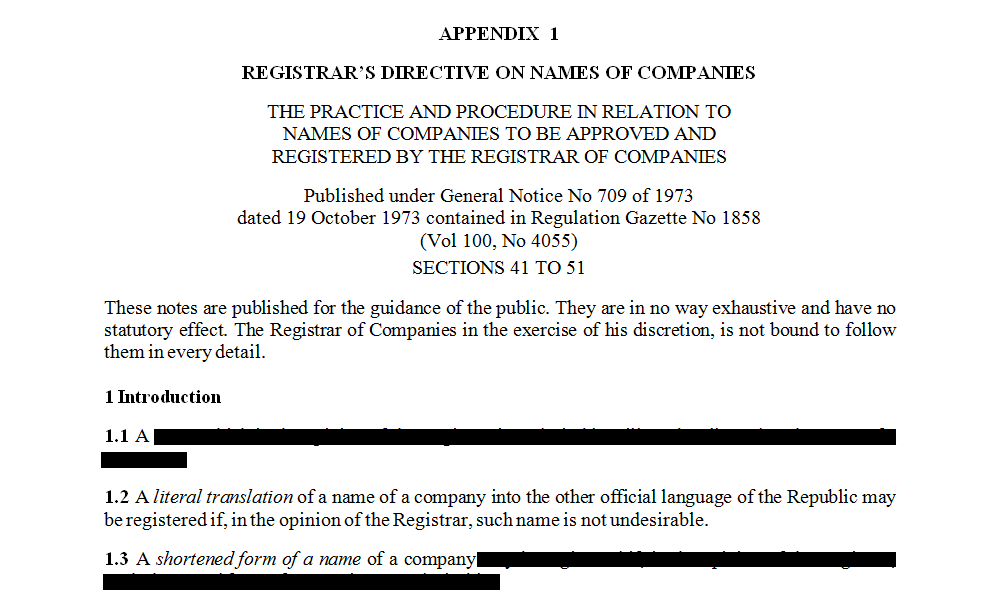
APPENDIX 1 REGISTRAR’S DIRECTIVE ON NAMES OF COMPANIES
FREE

Ask the similar questions
APPENDIX 1 REGISTRAR’S DIRECTIVE ON NAMES OF COMPANIES
the practice and procedure in relation to names of companies to be approved and registered by the registrar of companies
Registrar’s Directive on Names of Companies
Company names have been enjoying statutory protection in this country since days prior to the merging of the colonies into the Union of South Africa in 1910.
Although, only the Transvaal and the Cape colonies had legislation for protection of company names, upon the attainment of the Union, the Companies Act 46 of 1926, consolidated the corporate laws and applied to all the provinces of the Union.
Almost fifty years later, the Companies Act 61 of 1973 (replaced the 1926 Companies Act) provides a guideline for the incorporation of companies and determines how the names of companies must be registered.
When a new company is being formed it is strictly required that the company name be registered with the Registrar of Companies, and may contain words in any language, certain symbols, any letters, numbers or punctuation either alone or in combination. Moreover, it does not matter if the words are in common use or not.
The common principle regarding company names amongst all three pieces of legislation is that no company should be registered under a name identical or confusingly similar or so nearly resembling the name of another company as to be calculated to deceive or falsely implying or suggesting association between the one company and another person or entity.
This principle has over the years metamorphosed in different syntaxes and contexts, although the most noteworthy for its all-encompassing effect is the concept of “undesirability” ushered in by section 41 of the Companies Act 61 of 1973 (the 1973 Companies Act).
Section 41 reads as follows:
“No memorandum containing a name for a company to be incorporated shall be registered if in the opinion of the Registrar the name is undesirable.” The Registrar of Companies operates under the Companies Act, which prohibits registration of “offensive and undesirable names”. Offensive or undesirable names include:
• a name that is identical or confusingly similar to a registered trade mark unless a document signed by the owner of the trade mark and indicating consent to its use is provided;
• a name that suggests an association with the State or any of its agencies, a foreign government or an embassy, high commission or consulate, or a county government;
• a name that comprises an acronym that will render its use vague or uncertain;
• a name that the Registrar believes, on reasonable grounds, that there is reasonable possibility that it could offend members of a particular community or ethnic or racial group; or
• a name that includes "co-operative", "society" or "trade union "or any variant or synonym of these words.
The Registrar has powers to compel a company to change its name if it is similar to another company’s name, or the name would have appeared in the index of names at the time of registration of the infringing company. This would include an offensive or undesirable name.
Where a company does not comply with the directive to change its name within 14 days, the Registrar has powers to strike off the company from the register of companies.
This dissolution of the company does not negate the liability of any officer or member of the company. The Companies Act does not provide for third parties to make applications to the Registrar, who is expected to act on his own motion.
A third party may however write a formal letter to the Registrar drawing his attention to the infringing company name and stating reasons why the name is offensive or undesirable. The premise of this is that the company ought not to have been registered in the first place with a prohibited name.
Requirements for a Company Name
Certain words must appear in, or at the end of, a business’s name:
1. a profit company’s name may be its registration number, but must then immediately be followed by the expression “(South Africa)”;
2. if the company’s Memorandum of Incorporation (MOI), which is the company’s constitutional document, includes any provision restricting or prohibiting the amendment of any particular provision of the MOI, the name must end in “(RF)”;
3. a company name must end with one of the following expressions, as appropriate for the category of the particular company:
• in the case of a personal liability company, the name must end in “Incorporated” or “Inc.”;
• in the case of a private company, the name must end in “Proprietary Limited” or “(Pty) Ltd.”;
• in the case of a public company, the name must end in “Limited” or “Ltd.”;
• In the case of a state-owned company, the name must end in “SOC Ltd.”;
in the case of a non-profit company, the name must end in “NPC”;
•
• • in terms of the Companies Act, a company is required to display its registered name and registration number on all forms, notices and correspondence, electronic or otherwise, including letters, invoices, receipts, delivery notes, and all bills of exchange, promissory notes, endorsements, cheques and orders for money or goods. Failure to do so constitutes an offence punishable with a fine and/or imprisonment;
• a sole proprietor can trade under his own name, or can choose a different business name. If a business name is chosen which differs from the sole proprietor’s own name, the sole proprietor must include his own name and the business address on all letterheads and written communications;
• a partnership is required to include the names of all partners and the address of the main office on all letterheads, order forms, receipts and even invoices. If there are numerous partners, it is also acceptable to state where a list of partners may be found.
Registrar’s Directive on Names of Companies
Company names have been enjoying statutory protection in this country since days prior to the merging of the colonies into the Union of South Africa in 1910.
Although, only the Transvaal and the Cape colonies had legislation for protection of company names, upon the attainment of the Union, the Companies Act 46 of 1926, consolidated the corporate laws and applied to all the provinces of the Union.
Almost fifty years later, the Companies Act 61 of 1973 (replaced the 1926 Companies Act) provides a guideline for the incorporation of companies and determines how the names of companies must be registered.
When a new company is being formed it is strictly required that the company name be registered with the Registrar of Companies, and may contain words in any language, certain symbols, any letters, numbers or punctuation either alone or in combination. Moreover, it does not matter if the words are in common use or not.
The common principle regarding company names amongst all three pieces of legislation is that no company should be registered under a name identical or confusingly similar or so nearly resembling the name of another company as to be calculated to deceive or falsely implying or suggesting association between the one company and another person or entity.
This principle has over the years metamorphosed in different syntaxes and contexts, although the most noteworthy for its all-encompassing effect is the concept of “undesirability” ushered in by section 41 of the Companies Act 61 of 1973 (the 1973 Companies Act).
Section 41 reads as follows:
“No memorandum containing a name for a company to be incorporated shall be registered if in the opinion of the Registrar the name is undesirable.” The Registrar of Companies operates under the Companies Act, which prohibits registration of “offensive and undesirable names”. Offensive or undesirable names include:
• a name that is identical or confusingly similar to a registered trade mark unless a document signed by the owner of the trade mark and indicating consent to its use is provided;
• a name that suggests an association with the State or any of its agencies, a foreign government or an embassy, high commission or consulate, or a county government;
• a name that comprises an acronym that will render its use vague or uncertain;
• a name that the Registrar believes, on reasonable grounds, that there is reasonable possibility that it could offend members of a particular community or ethnic or racial group; or
• a name that includes "co-operative", "society" or "trade union "or any variant or synonym of these words.
The Registrar has powers to compel a company to change its name if it is similar to another company’s name, or the name would have appeared in the index of names at the time of registration of the infringing company. This would include an offensive or undesirable name.
Where a company does not comply with the directive to change its name within 14 days, the Registrar has powers to strike off the company from the register of companies.
This dissolution of the company does not negate the liability of any officer or member of the company. The Companies Act does not provide for third parties to make applications to the Registrar, who is expected to act on his own motion.
A third party may however write a formal letter to the Registrar drawing his attention to the infringing company name and stating reasons why the name is offensive or undesirable. The premise of this is that the company ought not to have been registered in the first place with a prohibited name.
Requirements for a Company Name
Certain words must appear in, or at the end of, a business’s name:
1. a profit company’s name may be its registration number, but must then immediately be followed by the expression “(South Africa)”;
2. if the company’s Memorandum of Incorporation (MOI), which is the company’s constitutional document, includes any provision restricting or prohibiting the amendment of any particular provision of the MOI, the name must end in “(RF)”;
3. a company name must end with one of the following expressions, as appropriate for the category of the particular company:
• in the case of a personal liability company, the name must end in “Incorporated” or “Inc.”;
• in the case of a private company, the name must end in “Proprietary Limited” or “(Pty) Ltd.”;
• in the case of a public company, the name must end in “Limited” or “Ltd.”;
• In the case of a state-owned company, the name must end in “SOC Ltd.”;
in the case of a non-profit company, the name must end in “NPC”;
•
• • in terms of the Companies Act, a company is required to display its registered name and registration number on all forms, notices and correspondence, electronic or otherwise, including letters, invoices, receipts, delivery notes, and all bills of exchange, promissory notes, endorsements, cheques and orders for money or goods. Failure to do so constitutes an offence punishable with a fine and/or imprisonment;
• a sole proprietor can trade under his own name, or can choose a different business name. If a business name is chosen which differs from the sole proprietor’s own name, the sole proprietor must include his own name and the business address on all letterheads and written communications;
• a partnership is required to include the names of all partners and the address of the main office on all letterheads, order forms, receipts and even invoices. If there are numerous partners, it is also acceptable to state where a list of partners may be found.
Legal App FREE Download - We Handle Your Case On The Go