
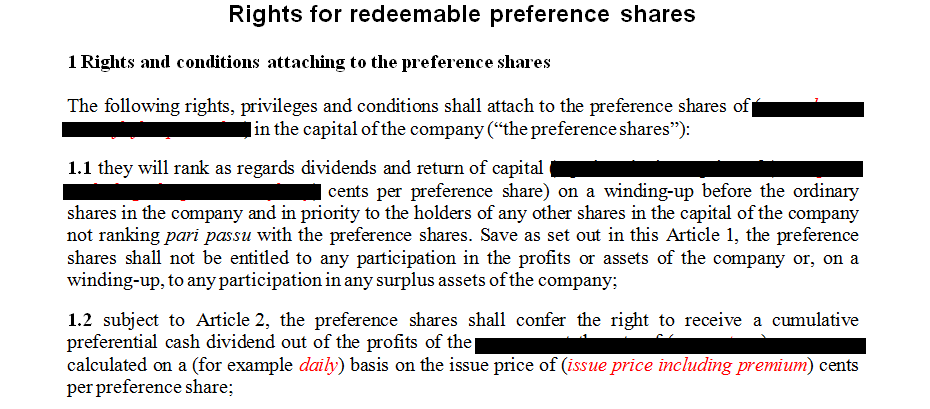
Rights for redeemable preference shares
FREE

Ask the similar questions
Rights for redeemable preference shares
Rights for Redeemable Preference Shares
What are redeemable preference shares?
Redeemable preference shares are a type of preference share. A company issues them to shareholders and later redeems them. This means the company can buy back the shares at a later date. Non- redeemable preference shares do exist, although companies cannot redeem them.
The issue of redeemable preference shares is a common source of funding for companies in South Africa and is also frequently resorted to by the banking sector to raise capital. It has the advantage of being less costly than direct loan funding and also of providing a source of tax-free dividends for investors.
The issue by companies of longer-term redeemable preference shares which do not trigger the anti-avoidance provisions of the Income Tax Act aimed at preference share investments that are regarded as essentially short-term loans, is therefore still widely used to provide access to funding.
Who Has the Power to Issue Redeemable Preference Shares?
A company has the power to issue redeemable preference shares under the Companies Act 2008. The Companies Act provides that a company’s power to issue shares includes the power to issue preference shares. This includes redeemable preference shares. However, the terms of the redeemable preference shares, including when a company can redeem them, must be:
• approved by a special resolution of shareholders; or
• set out in the company’s Memorandum of Incorporation.
What Are the Key Terms of Redeemable Preference Shares?
Companies issue redeemable preference shares on the terms that they are liable to be redeemed. They are redeemable at:
• a fixed time or on the happening of a particular event;
• the company’s option; or
• the shareholder’s option.
A special resolution agreed to by shareholders, or the company’s MOI, will set out the key terms of the redeemable preference shares.
These terms are in respect of:
• repayment of capital;
• participation in surplus assets and profits;
• cumulative and non-cumulative dividends;
• voting; and
• priority of payment of capital and dividends in relation to other shares or classes of preference shares.
When Can a Company Redeem These Shares?
• A company can only redeem redeemable preference shares per the terms upon which the shares are on issue. The company cannot redeem the shares unless they are fully paid-up and out of profits, or the proceeds of a new issue of shares is made for the purpose of redemption.
These restrictions exist to prevent redemption from reducing a company’s capital to the potential disadvantage of creditors.
• Even if a company redeems the shares without meeting the requirements, the company will not be guilty of an offence.
Furthermore, the redemption transaction will still be valid. However, any person involved in the contravention, such as a director, may face penalties.
Is shareholder approval necessary to approve the redemption of redeemable preference shares by the company?
• Shareholder approval is not necessary to approve the redemption of shares, so long as the company redeems the shares on their terms.
How much will shareholders be paid for their redeemable preference Shares when they are redeemed?
• Once the company has redeemed the shares, it will pay the shareholder. The company will pay them in accordance with the share price in the terms for the shares.
What Happens to These Shares When the Company Redeems Them?
• Upon redemption, the redeemable preference shares are cancelled. You should remember that a company’s redemption of the shares eliminates any dividend rights attached to them. An exception to this is where the terms of issue specify otherwise.
For example, the terms may specify that shareholders will receive a dividend payment out of any profits the company has made on completion of the redemption.
Are there other ways the company can buy back redeemable preference shares?
• A company can redeem and cancel shares in a selective reduction of capital. Such reduction has to be approved by special resolution of the redeemable preference shareholders, as well as by a company resolution in a general meeting.
• Furthermore, a company can redeem shares under a selective buy-back on terms which are different from the original share terms. To do this, the shareholders having their shares bought back need to accept the buy-back terms.
If shares are bought back in this way, the funds to pay for the shares do not need to be paid out of profit. However, the buy-back rules require that the redemption must not materially prejudice the company’s ability to pay its creditors.
Advantages of Redeemable Preference Shares
• Issuing redeemable preferential shares provides the company with an option to choose between whether to repurchase shares or redeem shares depending on the market condition.
• The company redeems shares when it decides to pay back the shareholders. It is a way of paying the shareholders similar to paying dividends. When shares are redeemed by the companies, the number of total shares outstanding reduces for the company, and the earning per share of the company increases, which leads to the increase in the share price.
• By redeeming shares, the company, most of the time, get rid of shares that were paying coupon rates, which are much higher than the current dividend yield for the equity share, thus increasing the value for the existing shareholders of the company.
• Redeemable preferential shares often provide exit opportunities for venture capital funds, which are provided with a predetermined exit option at a predetermined time and predetermined price point.
Disadvantages of Redeemable Preference Shares
The disadvantages of redeemable preference shares are as follows-
• These kinds of shares are feasible for the companies to redeem only when the call price of the shares is lower than the current market price of the shares. Otherwise, it’s logical for the company to go for share repurchases instead.
• The company needs to wait for the time predetermined while issuing the shares before being able to redeem the shares.
Important Points to Note
Important points regarding Redemption of Preference Shares:
• The company can only redeem shares if it has issued redeemable preference shares. Otherwise, the company does not have the option to redeem its shares.
• If a company has issued redeemable preference shares, then it provides the company with an option to choose between whether to repurchase shares or redeem shares depending on the market condition.
What are redeemable preference shares?
Redeemable preference shares are a type of preference share. A company issues them to shareholders and later redeems them. This means the company can buy back the shares at a later date. Non- redeemable preference shares do exist, although companies cannot redeem them.
The issue of redeemable preference shares is a common source of funding for companies in South Africa and is also frequently resorted to by the banking sector to raise capital. It has the advantage of being less costly than direct loan funding and also of providing a source of tax-free dividends for investors.
The issue by companies of longer-term redeemable preference shares which do not trigger the anti-avoidance provisions of the Income Tax Act aimed at preference share investments that are regarded as essentially short-term loans, is therefore still widely used to provide access to funding.
Who Has the Power to Issue Redeemable Preference Shares?
A company has the power to issue redeemable preference shares under the Companies Act 2008. The Companies Act provides that a company’s power to issue shares includes the power to issue preference shares. This includes redeemable preference shares. However, the terms of the redeemable preference shares, including when a company can redeem them, must be:
• approved by a special resolution of shareholders; or
• set out in the company’s Memorandum of Incorporation.
What Are the Key Terms of Redeemable Preference Shares?
Companies issue redeemable preference shares on the terms that they are liable to be redeemed. They are redeemable at:
• a fixed time or on the happening of a particular event;
• the company’s option; or
• the shareholder’s option.
A special resolution agreed to by shareholders, or the company’s MOI, will set out the key terms of the redeemable preference shares.
These terms are in respect of:
• repayment of capital;
• participation in surplus assets and profits;
• cumulative and non-cumulative dividends;
• voting; and
• priority of payment of capital and dividends in relation to other shares or classes of preference shares.
When Can a Company Redeem These Shares?
• A company can only redeem redeemable preference shares per the terms upon which the shares are on issue. The company cannot redeem the shares unless they are fully paid-up and out of profits, or the proceeds of a new issue of shares is made for the purpose of redemption.
These restrictions exist to prevent redemption from reducing a company’s capital to the potential disadvantage of creditors.
• Even if a company redeems the shares without meeting the requirements, the company will not be guilty of an offence.
Furthermore, the redemption transaction will still be valid. However, any person involved in the contravention, such as a director, may face penalties.
Is shareholder approval necessary to approve the redemption of redeemable preference shares by the company?
• Shareholder approval is not necessary to approve the redemption of shares, so long as the company redeems the shares on their terms.
How much will shareholders be paid for their redeemable preference Shares when they are redeemed?
• Once the company has redeemed the shares, it will pay the shareholder. The company will pay them in accordance with the share price in the terms for the shares.
What Happens to These Shares When the Company Redeems Them?
• Upon redemption, the redeemable preference shares are cancelled. You should remember that a company’s redemption of the shares eliminates any dividend rights attached to them. An exception to this is where the terms of issue specify otherwise.
For example, the terms may specify that shareholders will receive a dividend payment out of any profits the company has made on completion of the redemption.
Are there other ways the company can buy back redeemable preference shares?
• A company can redeem and cancel shares in a selective reduction of capital. Such reduction has to be approved by special resolution of the redeemable preference shareholders, as well as by a company resolution in a general meeting.
• Furthermore, a company can redeem shares under a selective buy-back on terms which are different from the original share terms. To do this, the shareholders having their shares bought back need to accept the buy-back terms.
If shares are bought back in this way, the funds to pay for the shares do not need to be paid out of profit. However, the buy-back rules require that the redemption must not materially prejudice the company’s ability to pay its creditors.
Advantages of Redeemable Preference Shares
• Issuing redeemable preferential shares provides the company with an option to choose between whether to repurchase shares or redeem shares depending on the market condition.
• The company redeems shares when it decides to pay back the shareholders. It is a way of paying the shareholders similar to paying dividends. When shares are redeemed by the companies, the number of total shares outstanding reduces for the company, and the earning per share of the company increases, which leads to the increase in the share price.
• By redeeming shares, the company, most of the time, get rid of shares that were paying coupon rates, which are much higher than the current dividend yield for the equity share, thus increasing the value for the existing shareholders of the company.
• Redeemable preferential shares often provide exit opportunities for venture capital funds, which are provided with a predetermined exit option at a predetermined time and predetermined price point.
Disadvantages of Redeemable Preference Shares
The disadvantages of redeemable preference shares are as follows-
• These kinds of shares are feasible for the companies to redeem only when the call price of the shares is lower than the current market price of the shares. Otherwise, it’s logical for the company to go for share repurchases instead.
• The company needs to wait for the time predetermined while issuing the shares before being able to redeem the shares.
Important Points to Note
Important points regarding Redemption of Preference Shares:
• The company can only redeem shares if it has issued redeemable preference shares. Otherwise, the company does not have the option to redeem its shares.
• If a company has issued redeemable preference shares, then it provides the company with an option to choose between whether to repurchase shares or redeem shares depending on the market condition.
Legal App FREE Download - We Handle Your Case On The Go