
Affidavit verifying loss of share certificate
FREE

Ask the similar questions
Affidavit verifying loss of share certificate
Affidavit verifying loss of share certificate
Affidavit Verifying Loss of Share Certificate
A share certificate is legal proof of ownership of a company. It is a signed document, signed by the directors of the company, and shows information such as the name and surname of the individual, the identity number of the person, residential address, the quantity of shares owned and the actual share numbers owned.
Share certificates are not issued by CIPC the registrar of companies, nor does CIPC keep track of the ownership of your company at the present time. They keep track of directors, namely people responsible for the company legally and appointed by the shareholders. Subsequently all share certificates, share registers are supposed to be maintained by the directors of the company in a company register.
The modern world is electronic. Many workplaces have gone paperless, and even personal transactions are no longer confined to physical document exchange. However, remnants of old systems and habits remain and there are certain areas in which paper documents remain fairly common. One of those areas is in the representation and trading of stock shares.
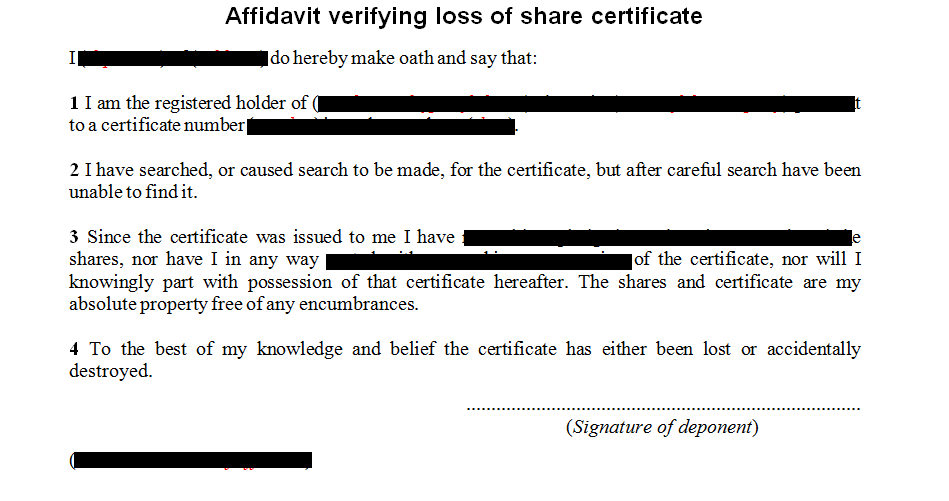
By some estimates, there are as many as 50 million paper stocks certificates remaining in circulation. Individual investors keep these documents in various locations, ranging from organized files in a safe-deposit box to cardboard boxes in the garage. No matter the system, physical certificates are often misplaced or destroyed accidentally. In such cases, the stockholder will need to replace the documents, a process that starts with the completion of an affidavit of lost stock certificate.
Steps the Shareholder Must Follow if a Certificate Is Lost
Each company’s procedures may vary. However, there are some steps that the shareholder must follow. First, the shareholder must describe the loss and any facts surrounding the loss in an affidavit. Second, the shareholder may be required to purchase an indemnity bond. The purpose of the bond is to protect the corporation and the agent in case the lost certificate is somehow redeemed by another party at a later date. (Think of it simply as additional insurance). When the necessary information has been provided and the necessary steps are taken, a new certificate will be issued.
The Bottom Line
Losing a share certificate can be remedied by contacting the company's investor relations department. This department will inform the shareholder how to contact the transfer agent who can place a stop payment on the shares and reissue a new certificate. The shareholder may have to complete an affidavit and purchase an indemnity bond. However, stock certificates are no longer needed in today's world of electronic communication, and even if an investor loses their certificate, they still own the shares.
Affidavit Verifying Loss of Share Certificate
A share certificate is legal proof of ownership of a company. It is a signed document, signed by the directors of the company, and shows information such as the name and surname of the individual, the identity number of the person, residential address, the quantity of shares owned and the actual share numbers owned.
Share certificates are not issued by CIPC the registrar of companies, nor does CIPC keep track of the ownership of your company at the present time. They keep track of directors, namely people responsible for the company legally and appointed by the shareholders. Subsequently all share certificates, share registers are supposed to be maintained by the directors of the company in a company register.
The modern world is electronic. Many workplaces have gone paperless, and even personal transactions are no longer confined to physical document exchange. However, remnants of old systems and habits remain and there are certain areas in which paper documents remain fairly common. One of those areas is in the representation and trading of stock shares.
By some estimates, there are as many as 50 million paper stocks certificates remaining in circulation. Individual investors keep these documents in various locations, ranging from organized files in a safe-deposit box to cardboard boxes in the garage. No matter the system, physical certificates are often misplaced or destroyed accidentally. In such cases, the stockholder will need to replace the documents, a process that starts with the completion of an affidavit of lost stock certificate.
Steps the Shareholder Must Follow if a Certificate Is Lost
Each company’s procedures may vary. However, there are some steps that the shareholder must follow. First, the shareholder must describe the loss and any facts surrounding the loss in an affidavit. Second, the shareholder may be required to purchase an indemnity bond. The purpose of the bond is to protect the corporation and the agent in case the lost certificate is somehow redeemed by another party at a later date. (Think of it simply as additional insurance). When the necessary information has been provided and the necessary steps are taken, a new certificate will be issued.
The Bottom Line
Losing a share certificate can be remedied by contacting the company's investor relations department. This department will inform the shareholder how to contact the transfer agent who can place a stop payment on the shares and reissue a new certificate. The shareholder may have to complete an affidavit and purchase an indemnity bond. However, stock certificates are no longer needed in today's world of electronic communication, and even if an investor loses their certificate, they still own the shares.
Legal App FREE Download - We Handle Your Case On The Go