
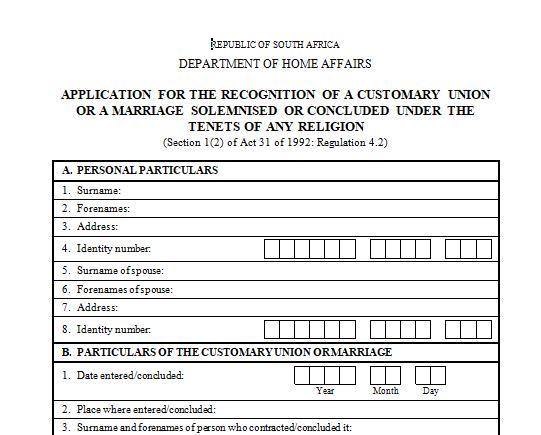
Application For The Recognition Of A Customary Union Or A Marriage Solemnised
FREE

Ask the similar questions
Application For The Recognition Of A Customary Union Or A Marriage Solemnised
Application for the Recognition of a Customary Union or a Marriage Solemnized
Application for the Recognition of a Customary Union or a Marriage Solemnized or Concluded under the Tenets of any Religion
Registration of customary marriages:
Traditional marriages will only be recognised as lawful if they have been registered. Even if lobola was paid and the marriage was celebrated
along with customary rituals and laws, it must be registered with the Department of Home Affairs.
This is a condition of the African Customary Marriages Act, which came into operation in November 2000. In line with this law, the marriage can
be registered at any office of the Department of Home Affairs within a period of three months after the customary wedding took place.
This can be done at any office of the Department of Home Affairs or through a designated traditional leader in areas where there are no Home Affairs offices.
The following people should present themselves at either a Home Affairs office or a traditional leader to register a customary marriage:
• the two spouses with copies of their valid identity books and a lobola agreement, if available;
• at least one witness from the brides family;
• at least one witness from the grooms family;
• and/or the representative of each family.
If either or both of the spouses were minors at the time of the customary marriage, the parents should also be present when the
request to register the marriage is made.
Although the Act states that both partners must be 18 years or older Before they may get married, exceptions can be made for younger
couples. Both parents of the partners must give their approval and must be present when the marriage is registered.
At present, the definition of customary marriages as given by law only includes marriages that take place along with any of the African
customary marriages. It does not include customary marriages entered into within other religions, for example Hindu or Muslim.
An application for the registration of a customary marriage must substantially correspond with the Form BI-130 accessed from
www.LawyersEzyFind.co.za which is duly confirmed and signed before a:-
(a) registering officer; or
(b) designated person, who has been designated as such by the Director-General to perform functions in terms of the regulations of
the Recognition of Customary Marriages Act 120 of 1998 (RCMA).
The application must be lodged with a registering officer or designated person who must issue the applicant with an acknowledgment of receipt.
Thereafter, the designated person with whom the application is lodged must forward the application to the nearest regional or district office of the Department.
The registering officer, who is not an official of the Department must, after registration of the customary marriage, forward the application to
the nearest regional or district office of the Department for inclusion of the particulars of the customary marriage in the population register.
In terms of section 26(1) of the Births and Deaths Registration Act 51 1992, a woman after her marriage may:
a) assume her husband’s surname;
b) resume a surname which she bore at any prior time;
c) join her maiden surname or a previous married surname with that of her husband; or
d) retain her maiden name.
The applicant is required to indicate in writing the surname which she wishes to be recorded in the population register.
If a husband enters into a second or consecutive marriage after 15 November 2000, the written contract which will regulate the future
matrimonial property system of his marriage together with the order of court which approved such contract, must be annexed to the Form. A
further customary marriage cannot be registered if the aforementioned contract or order of court is not attached.
The Director-General may on application:
• issue a duplicate of the customary marriage certificate;
• issue an extract from the customary marriage register; or
• furnish a reproduction of the customary marriage register or
of any supporting documentation in relation to the register.
Fees
The following fees are payable to the Department:
(a) Duplicate customary marriage certificate: R6. 00
(b) Search and reproduction of customary marriage register or of any supporting documentation in relation to the register: R40. 00
(if needed for official purposes by a Government institution it is free of charge).
(c) Furnishing of an extract from the customary marriage register: R40. 00
A fee of R10.00 is payable to a designated person in respect of an application for registration of a customary marriage lodged with the
designated person.
Marriage Solemnized or Concluded under the Tenets of any Religion
Marriage by Hindu Rites:
• There is no automatic legal recognition of Hindu marriages in terms of The Marriages Act. Instead, a marriage by Hindu rites is
governed by the tenets of the Hindu faith and not by civil law.
• If the parties wish to be bound by South African civil law, they must formally get married by a person who is registered in terms of the
Marriages Act and who may perform a civil marriage in tandem with the customary marriage, and issue the parties with a marriage
certificate in terms of the Marriage Act 25 of 1961.
• If the parties are married by Hindu rites, but no civil marriage is registered, then they are not married in the eyes of South African law.
Marriage by Muslim Rites
• Similarly, parties married by Islamic or Muslim rites are regarded as unmarried.
• However, by registering a marriage in terms of the Marriages Act, spouses can obtain recognition and regulate the proprietary consequences of their marriage.
• The role of the Muslim cleric (Imaam/ Alim), if he is an authorised marriage officer, is to solemnise the marriage in terms of the
Marriage Act, after the Islamic marriage ceremony (Nikah). He must thereafter register the marriage formally with the Department
of Home Affairs.
Application for the Recognition of a Customary Union or a Marriage Solemnized or Concluded under the Tenets of any Religion
Registration of customary marriages:
Traditional marriages will only be recognised as lawful if they have been registered. Even if lobola was paid and the marriage was celebrated
along with customary rituals and laws, it must be registered with the Department of Home Affairs.
This is a condition of the African Customary Marriages Act, which came into operation in November 2000. In line with this law, the marriage can
be registered at any office of the Department of Home Affairs within a period of three months after the customary wedding took place.
This can be done at any office of the Department of Home Affairs or through a designated traditional leader in areas where there are no Home Affairs offices.
The following people should present themselves at either a Home Affairs office or a traditional leader to register a customary marriage:
• the two spouses with copies of their valid identity books and a lobola agreement, if available;
• at least one witness from the brides family;
• at least one witness from the grooms family;
• and/or the representative of each family.
If either or both of the spouses were minors at the time of the customary marriage, the parents should also be present when the
request to register the marriage is made.
Although the Act states that both partners must be 18 years or older Before they may get married, exceptions can be made for younger
couples. Both parents of the partners must give their approval and must be present when the marriage is registered.
At present, the definition of customary marriages as given by law only includes marriages that take place along with any of the African
customary marriages. It does not include customary marriages entered into within other religions, for example Hindu or Muslim.
An application for the registration of a customary marriage must substantially correspond with the Form BI-130 accessed from
www.LawyersEzyFind.co.za which is duly confirmed and signed before a:-
(a) registering officer; or
(b) designated person, who has been designated as such by the Director-General to perform functions in terms of the regulations of
the Recognition of Customary Marriages Act 120 of 1998 (RCMA).
The application must be lodged with a registering officer or designated person who must issue the applicant with an acknowledgment of receipt.
Thereafter, the designated person with whom the application is lodged must forward the application to the nearest regional or district office of the Department.
The registering officer, who is not an official of the Department must, after registration of the customary marriage, forward the application to
the nearest regional or district office of the Department for inclusion of the particulars of the customary marriage in the population register.
In terms of section 26(1) of the Births and Deaths Registration Act 51 1992, a woman after her marriage may:
a) assume her husband’s surname;
b) resume a surname which she bore at any prior time;
c) join her maiden surname or a previous married surname with that of her husband; or
d) retain her maiden name.
The applicant is required to indicate in writing the surname which she wishes to be recorded in the population register.
If a husband enters into a second or consecutive marriage after 15 November 2000, the written contract which will regulate the future
matrimonial property system of his marriage together with the order of court which approved such contract, must be annexed to the Form. A
further customary marriage cannot be registered if the aforementioned contract or order of court is not attached.
The Director-General may on application:
• issue a duplicate of the customary marriage certificate;
• issue an extract from the customary marriage register; or
• furnish a reproduction of the customary marriage register or
of any supporting documentation in relation to the register.
Fees
The following fees are payable to the Department:
(a) Duplicate customary marriage certificate: R6. 00
(b) Search and reproduction of customary marriage register or of any supporting documentation in relation to the register: R40. 00
(if needed for official purposes by a Government institution it is free of charge).
(c) Furnishing of an extract from the customary marriage register: R40. 00
A fee of R10.00 is payable to a designated person in respect of an application for registration of a customary marriage lodged with the
designated person.
Marriage Solemnized or Concluded under the Tenets of any Religion
Marriage by Hindu Rites:
• There is no automatic legal recognition of Hindu marriages in terms of The Marriages Act. Instead, a marriage by Hindu rites is
governed by the tenets of the Hindu faith and not by civil law.
• If the parties wish to be bound by South African civil law, they must formally get married by a person who is registered in terms of the
Marriages Act and who may perform a civil marriage in tandem with the customary marriage, and issue the parties with a marriage
certificate in terms of the Marriage Act 25 of 1961.
• If the parties are married by Hindu rites, but no civil marriage is registered, then they are not married in the eyes of South African law.
Marriage by Muslim Rites
• Similarly, parties married by Islamic or Muslim rites are regarded as unmarried.
• However, by registering a marriage in terms of the Marriages Act, spouses can obtain recognition and regulate the proprietary consequences of their marriage.
• The role of the Muslim cleric (Imaam/ Alim), if he is an authorised marriage officer, is to solemnise the marriage in terms of the
Marriage Act, after the Islamic marriage ceremony (Nikah). He must thereafter register the marriage formally with the Department
of Home Affairs.
Legal App FREE Download - We Handle Your Case On The Go