
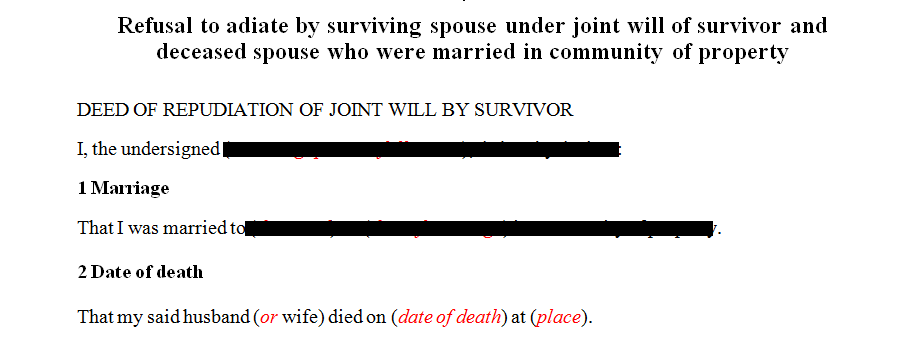
Refusal to adiate by surviving spouse under joint will of survivor and deceased spouse who were married in community of property
FREE

Ask the similar questions
Refusal to adiate by surviving spouse under joint will of survivor and deceased spouse who were married in community of property
Deed of repudiation (rejecting) of joint will by surviving spouse
Adiation: Adiation is the election by a beneficiary to accept the benefit conferred upon him in any testamentary disposition. The legal
consequences of acceptance or rejection must be explained to the beneficiary.
The beneficiary must sign a Deed of Adiation, which should contain a certificate by an attorney confirming that the consequences of
acceptance and rejection of the terms of the will have been explained to the beneficiary, and that after such explanation the beneficiary has
deemed it convenient to accept the terms of the will. Conditional or partial adiation is not permitted.
Repudiation
Repudiation is the election by a beneficiary to reject the benefit conferred upon him in any testamentary disposition. The legal
consequences of acceptance or rejection must be explained to the beneficiary.
The beneficiary must sign a Deed of Repudiation, which should contain a certificate by an attorney confirming that the consequences of
repudiation and acceptance of the terms of the will have been explained to the beneficiary, and that after such explanation the
beneficiary has deemed it convenient to repudiate the terms of the will. Conditional or partial repudiation is not permissible.
Consequences of adiation and repudiation
Once the survivor accepts the will, massing takes place and he loses his rights to the assets that he contributed to the massing. The
disadvantage of massing is that the surviving testator will no longer be able to alienate or mortgage the property massed. He also loses his
ability to vary or revoke the joint will relating to his share of the massed estate.
If the surviving testator repudiates the joint will, the will shall only have application over the estate of the deceased testator. The surviving
testator will not be allowed to receive any benefit from the deceased testator in terms of the will, and shall keep his own estate which he may alienate as he wishes.
Example of clauses effecting massing
1. “We provide that when the first of us dies, our respective estates shall merge as one estate which we bequeath to our children.”
2. “We consolidate and mass our respective out of community of property estates and appoint the children born or to be born of our
marriage to be the sole and universal heirs of the massed estate, subject to a usufruct thereover in favour of the survivor of us during his/her lifetime.”
3. Partial massing:
“We hereby mass our separately held shares in ABC Company (Pty) Ltd and bequeath the said shares to our children born of our
marriage who survive the first dying of us. We bequeath the residue of the estate of the first dying of us to the survivor of us.”
Adiation certificate example
Estate Late …………………………. No………..
Whereas it has been explained to me that the Last Will and Testament of the deceased and myself dated ……. created
a massing of our separate estates into a consolidated whole which has been bequeathed to the heirs subject to the provisions of the said will;
Whereas the effect of such massing have been fully explained to me and I am fully aware of my legal position and that I am
acquainted with the result of adiating and/or repudiating the provisions of the said will;
Whereas I am aware that my decision to adiate/repudiate is irrevocable; and
After due consideration I have decided to adiate/repudiate the conditions of the said will.
Signed at ……….. on this the ….. day of …………………
Full names ……………
Signature ……………..
I ………….. legal practitioner for …………………. hereby confirm that
the legal position and the effects of adiation and repudiation were
explained to …………… and I am satisfied that he/she understood the meaning and effect of the above adiation/repudiation.
Massing of Estates Estate massing involves two or more testators who consolidate a portion or the whole of their respective estates and jointly dispose of the
consolidated estate in a joint or mutual will. This is subject to the survivor receiving a limited beneficial interest in the estate such as a
fideicommissum or a usufruct. Massing will take place when the survivor of them accepts the terms of the will, that is, when the survivor adiates.
(Fideicommissum -owner of property transfers that property to another person, subject to it being transferred from that person to another
person at a later stage;
Usufruct – this enables the holder of the right to use certain property belonging to someone else and to enjoy the fruits subject to the
condition that the substance of the property be maintained).
Estate massing is referred to in Section 37 of the Administration of Estates Act and should therefore be relied upon when considering the consolidation of two separate estates.
Massing is not limited to only spouses who are married in community of property to each other, any two or more persons can mass their
respective estates.
When there is massing of only a portion of the joint estate, the survivor is at liberty to make a will dealing with the portion of the
estate that has not been massed.
Upon the death of the first dying testator the other testator(s) have an election to either accept (adiate) of decline (repudiate) the will.
Adiation: Adiation is the election by a beneficiary to accept the benefit conferred upon him in any testamentary disposition. The legal
consequences of acceptance or rejection must be explained to the beneficiary.
The beneficiary must sign a Deed of Adiation, which should contain a certificate by an attorney confirming that the consequences of
acceptance and rejection of the terms of the will have been explained to the beneficiary, and that after such explanation the beneficiary has
deemed it convenient to accept the terms of the will. Conditional or partial adiation is not permitted.
Repudiation
Repudiation is the election by a beneficiary to reject the benefit conferred upon him in any testamentary disposition. The legal
consequences of acceptance or rejection must be explained to the beneficiary.
The beneficiary must sign a Deed of Repudiation, which should contain a certificate by an attorney confirming that the consequences of
repudiation and acceptance of the terms of the will have been explained to the beneficiary, and that after such explanation the
beneficiary has deemed it convenient to repudiate the terms of the will. Conditional or partial repudiation is not permissible.
Consequences of adiation and repudiation
Once the survivor accepts the will, massing takes place and he loses his rights to the assets that he contributed to the massing. The
disadvantage of massing is that the surviving testator will no longer be able to alienate or mortgage the property massed. He also loses his
ability to vary or revoke the joint will relating to his share of the massed estate.
If the surviving testator repudiates the joint will, the will shall only have application over the estate of the deceased testator. The surviving
testator will not be allowed to receive any benefit from the deceased testator in terms of the will, and shall keep his own estate which he may alienate as he wishes.
Example of clauses effecting massing
1. “We provide that when the first of us dies, our respective estates shall merge as one estate which we bequeath to our children.”
2. “We consolidate and mass our respective out of community of property estates and appoint the children born or to be born of our
marriage to be the sole and universal heirs of the massed estate, subject to a usufruct thereover in favour of the survivor of us during his/her lifetime.”
3. Partial massing:
“We hereby mass our separately held shares in ABC Company (Pty) Ltd and bequeath the said shares to our children born of our
marriage who survive the first dying of us. We bequeath the residue of the estate of the first dying of us to the survivor of us.”
Adiation certificate example
Estate Late …………………………. No………..
Whereas it has been explained to me that the Last Will and Testament of the deceased and myself dated ……. created
a massing of our separate estates into a consolidated whole which has been bequeathed to the heirs subject to the provisions of the said will;
Whereas the effect of such massing have been fully explained to me and I am fully aware of my legal position and that I am
acquainted with the result of adiating and/or repudiating the provisions of the said will;
Whereas I am aware that my decision to adiate/repudiate is irrevocable; and
After due consideration I have decided to adiate/repudiate the conditions of the said will.
Signed at ……….. on this the ….. day of …………………
Full names ……………
Signature ……………..
I ………….. legal practitioner for …………………. hereby confirm that
the legal position and the effects of adiation and repudiation were
explained to …………… and I am satisfied that he/she understood the meaning and effect of the above adiation/repudiation.
Massing of Estates Estate massing involves two or more testators who consolidate a portion or the whole of their respective estates and jointly dispose of the
consolidated estate in a joint or mutual will. This is subject to the survivor receiving a limited beneficial interest in the estate such as a
fideicommissum or a usufruct. Massing will take place when the survivor of them accepts the terms of the will, that is, when the survivor adiates.
(Fideicommissum -owner of property transfers that property to another person, subject to it being transferred from that person to another
person at a later stage;
Usufruct – this enables the holder of the right to use certain property belonging to someone else and to enjoy the fruits subject to the
condition that the substance of the property be maintained).
Estate massing is referred to in Section 37 of the Administration of Estates Act and should therefore be relied upon when considering the consolidation of two separate estates.
Massing is not limited to only spouses who are married in community of property to each other, any two or more persons can mass their
respective estates.
When there is massing of only a portion of the joint estate, the survivor is at liberty to make a will dealing with the portion of the
estate that has not been massed.
Upon the death of the first dying testator the other testator(s) have an election to either accept (adiate) of decline (repudiate) the will.
Legal App FREE Download - We Handle Your Case On The Go