
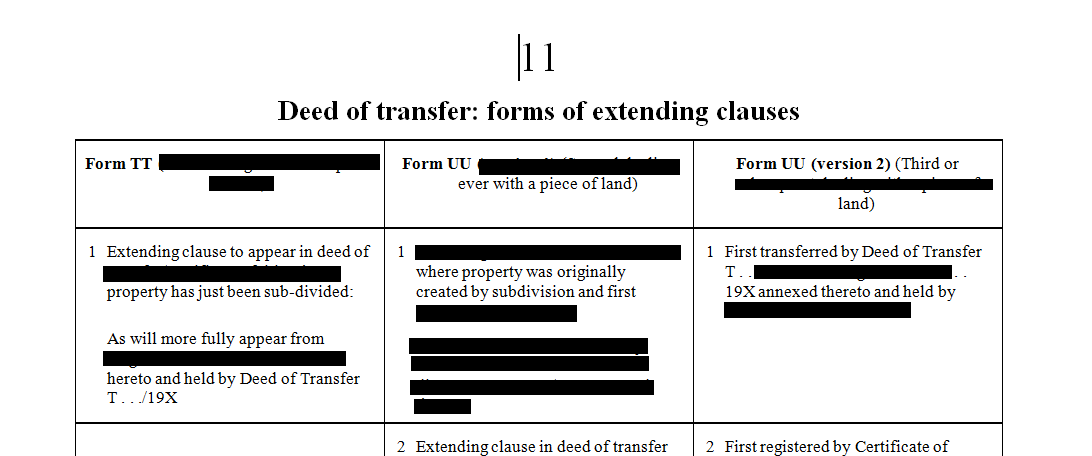
Deed of transfer: forms of extending clauses,divesting, consideration and value clauses.
FREE

Ask the similar questions
Deed of transfer: forms of extending clauses,divesting, consideration and value clauses.
Mixture of Clauses comprising of details relating to the transfer of property.
Deed of Transfer: Forms of Extending Clauses, Divesting, Consideration and Value Clauses
A deed of transfer is a legal document that indicates the transfer of a property from one person to another. It also indicates the chain of owners. This document serves as proof of ownership of the property.
The deed of transfer firstly stipulates the name of the conveyancer and the person for whom he/she is acting, as well as the power of attorney of the conveyancer granting him/her the authority to act.
The name of the person to whom the transfer will take place (the transferee) is then stated, followed by an accurate description of the property to be transferred. The transfer does not necessarily have to include a diagram of the property, but will include a reference to the original deed of transfer, to which such diagram is attached, or will refer to a general plan of the residential area or urban area where the property is situated.
The deed of transfer will then set out the various conditions of title that regulate the use of the property. These conditions usually place restrictions on how the land may be utilised.
Usually there are other conditions of title that may differ from property to property. For example, a servitude may be in existence which grants the municipality the right to install a drainage system across the property.
As soon as the deed of transfer executed has been submitted to the Registrar of Deeds, the buyer becomes the owner of the property.
A deed of transfer is the most common means by which land is transferred from one person to another. In fact, section 16 of the Deeds Registries Act 47 of 1937 provides that, save for exceptions, this will be the only means by which ownership of land is transferred.
Exceptions in the Deeds Registries Act:
• deed of grant (transfer from the State);
• endorsement in terms of section 16 (expropriation transfer);
• endorsement in terms of section 33 (transfer by order of Court);
• endorsement in terms of section 25(3) (transfer to unascertained children);
• endorsement in terms of section 45(1) (transfer to surviving spouse);
• endorsement in terms of section 45bis(1)(a) and (b) (transfer to a divorced spouse);
• endorsement in terms of section 45bis(1A) (a) and (b) (transfer to both divorced spouses);
• endorsement in terms of section 58(2) (insolvent estate transfers);
• withdrawal of an expropriation notice section 31(7);
• dissolution of a firm/partnership in terms of section 24bis(2).
• Deed Of Transfer Recitals (Causae): Donations
• Deed Of Transfer Recitals (Causae): Rectifications simultaneous transfer
Section 20 of the Act provides that a deed of transfer must be drawn in the forms prescribed by the Act and regulations, although minor deviations are permitted (regulation 82).
There are different forms of deed of transfer prescribed in the regulations to the Act:
• form E, which is used for sales, donations, inheritance, etc. (this is the most common form);
• partition transfers – form F;
• expropriation transfers – form G;
• transfer in compliance with a court order – form H;
• transfer in terms of certain other Acts – form DDD.
The Extending Clause
The extending clause (prescribed by regulation 26 and forms TT and UU) follows immediately after the property clause in a deed of transfer.
The purpose of the extending clause is twofold:
• it provides a reference to the diagram or general plan that was approved by the Surveyor-General for the land, so that an interested party can determine the whereabouts of the land, namely the boundaries of the land, its width and length, and its general situation in relation to adjoining land.
• it indicates the title under which the land was held at the time of execution of the current deed of transfer.
Extending clauses can take one of two forms:
1. As a diagram or original deed:
In respect of land which was not previously registered, this new piece of land will be represented on an approved diagram by the Surveyor-General or on a general plan. In this instance the extending clause might read as follows:
As will appear from the general plan/annexed diagram SG Number A 1711/1992 and held by deed of transfer (or grant or certificate of title) Number T 3578/1980. (See regulation 26 and prescribed form TT.)
The extending clause of the first deed of transfer following the diagram deed will read as follows:
First transferred (or registered) and still held by deed of transfer T3729/1993 with diagram SG Number A 1711/92 annexed thereto.
2. As a subsequent deed of transfer:
Here the extending clause might read as follows:
First transferred by deed of transfer (or grant) Number T 3729 1993 with diagram SG Number 1711/92 annexed thereto and held by deed of transfer (or grant) or certificate of title Number T 43165 2002.
The Divesting Clause
As the name implies, this clause declares the previous registered owner divested of his/her ownership. It is not necessary again to indicate the full marital status of the transferor(s), and parties can be merely referred to as married as aforesaid.
If an estate is the transferor, divest the “estate late Sipho Sitole” and, if a joint estate of a deceased and his/her spouse is involved, divest “the joint estate of the late Sipho Sitole and surviving spouse (or later deceased spouse)” (regulation 50(2)(c)). This must occur even where the executor in the estate acts alone in terms of the exceptions in section 21 of the Act.
The last part of the divesting clause where the rights of the State are reserved must be omitted in the case where transfer is in favour of the Republic of South Africa (regulation 35(1)(f)).
The Consideration Clause
Form E prescribes that only the purchase price must be embodied in the deed of transfer. Where transfer duty was paid on a higher amount than the purchase price, it is established practice that the amount on which transfer duty was paid is also stated in the deed of transfer, along with the reason why it differs from the sum of the consideration.
When the amount on which transfer duty was paid included other properties that are not transferred in the deed of transfer, this must be disclosed in the consideration clause.
Purchase Price/Value
The purchase price must either be a fixed amount (for example, R100 000.00) or be readily ascertainable (for example, R100.00 per square meter, including the correct size of the property).
Unless agreed otherwise, the purchase price is payable in a lump sum on transfer of the property to the buyer.
The guarantees referred to in the offer to purchase means that the purchaser furnishes the seller with a promise from a bank that the price will be paid in full once the property is registered in the name of the purchaser (the purchaser will then pay off this 'mortgage bond' to the bank).
Deed of Transfer: Forms of Extending Clauses, Divesting, Consideration and Value Clauses
A deed of transfer is a legal document that indicates the transfer of a property from one person to another. It also indicates the chain of owners. This document serves as proof of ownership of the property.
The deed of transfer firstly stipulates the name of the conveyancer and the person for whom he/she is acting, as well as the power of attorney of the conveyancer granting him/her the authority to act.
The name of the person to whom the transfer will take place (the transferee) is then stated, followed by an accurate description of the property to be transferred. The transfer does not necessarily have to include a diagram of the property, but will include a reference to the original deed of transfer, to which such diagram is attached, or will refer to a general plan of the residential area or urban area where the property is situated.
The deed of transfer will then set out the various conditions of title that regulate the use of the property. These conditions usually place restrictions on how the land may be utilised.
Usually there are other conditions of title that may differ from property to property. For example, a servitude may be in existence which grants the municipality the right to install a drainage system across the property.
As soon as the deed of transfer executed has been submitted to the Registrar of Deeds, the buyer becomes the owner of the property.
A deed of transfer is the most common means by which land is transferred from one person to another. In fact, section 16 of the Deeds Registries Act 47 of 1937 provides that, save for exceptions, this will be the only means by which ownership of land is transferred.
Exceptions in the Deeds Registries Act:
• deed of grant (transfer from the State);
• endorsement in terms of section 16 (expropriation transfer);
• endorsement in terms of section 33 (transfer by order of Court);
• endorsement in terms of section 25(3) (transfer to unascertained children);
• endorsement in terms of section 45(1) (transfer to surviving spouse);
• endorsement in terms of section 45bis(1)(a) and (b) (transfer to a divorced spouse);
• endorsement in terms of section 45bis(1A) (a) and (b) (transfer to both divorced spouses);
• endorsement in terms of section 58(2) (insolvent estate transfers);
• withdrawal of an expropriation notice section 31(7);
• dissolution of a firm/partnership in terms of section 24bis(2).
• Deed Of Transfer Recitals (Causae): Donations
• Deed Of Transfer Recitals (Causae): Rectifications simultaneous transfer
Section 20 of the Act provides that a deed of transfer must be drawn in the forms prescribed by the Act and regulations, although minor deviations are permitted (regulation 82).
There are different forms of deed of transfer prescribed in the regulations to the Act:
• form E, which is used for sales, donations, inheritance, etc. (this is the most common form);
• partition transfers – form F;
• expropriation transfers – form G;
• transfer in compliance with a court order – form H;
• transfer in terms of certain other Acts – form DDD.
The Extending Clause
The extending clause (prescribed by regulation 26 and forms TT and UU) follows immediately after the property clause in a deed of transfer.
The purpose of the extending clause is twofold:
• it provides a reference to the diagram or general plan that was approved by the Surveyor-General for the land, so that an interested party can determine the whereabouts of the land, namely the boundaries of the land, its width and length, and its general situation in relation to adjoining land.
• it indicates the title under which the land was held at the time of execution of the current deed of transfer.
Extending clauses can take one of two forms:
1. As a diagram or original deed:
In respect of land which was not previously registered, this new piece of land will be represented on an approved diagram by the Surveyor-General or on a general plan. In this instance the extending clause might read as follows:
As will appear from the general plan/annexed diagram SG Number A 1711/1992 and held by deed of transfer (or grant or certificate of title) Number T 3578/1980. (See regulation 26 and prescribed form TT.)
The extending clause of the first deed of transfer following the diagram deed will read as follows:
First transferred (or registered) and still held by deed of transfer T3729/1993 with diagram SG Number A 1711/92 annexed thereto.
2. As a subsequent deed of transfer:
Here the extending clause might read as follows:
First transferred by deed of transfer (or grant) Number T 3729 1993 with diagram SG Number 1711/92 annexed thereto and held by deed of transfer (or grant) or certificate of title Number T 43165 2002.
The Divesting Clause
As the name implies, this clause declares the previous registered owner divested of his/her ownership. It is not necessary again to indicate the full marital status of the transferor(s), and parties can be merely referred to as married as aforesaid.
If an estate is the transferor, divest the “estate late Sipho Sitole” and, if a joint estate of a deceased and his/her spouse is involved, divest “the joint estate of the late Sipho Sitole and surviving spouse (or later deceased spouse)” (regulation 50(2)(c)). This must occur even where the executor in the estate acts alone in terms of the exceptions in section 21 of the Act.
The last part of the divesting clause where the rights of the State are reserved must be omitted in the case where transfer is in favour of the Republic of South Africa (regulation 35(1)(f)).
The Consideration Clause
Form E prescribes that only the purchase price must be embodied in the deed of transfer. Where transfer duty was paid on a higher amount than the purchase price, it is established practice that the amount on which transfer duty was paid is also stated in the deed of transfer, along with the reason why it differs from the sum of the consideration.
When the amount on which transfer duty was paid included other properties that are not transferred in the deed of transfer, this must be disclosed in the consideration clause.
Purchase Price/Value
The purchase price must either be a fixed amount (for example, R100 000.00) or be readily ascertainable (for example, R100.00 per square meter, including the correct size of the property).
Unless agreed otherwise, the purchase price is payable in a lump sum on transfer of the property to the buyer.
The guarantees referred to in the offer to purchase means that the purchaser furnishes the seller with a promise from a bank that the price will be paid in full once the property is registered in the name of the purchaser (the purchaser will then pay off this 'mortgage bond' to the bank).
Legal App FREE Download - We Handle Your Case On The Go